what does the 3d molecular drawing bh3 molecular geometry
Chapter 7. Chemical Bonding and Molecular Geometry
7.6 Molecular Structure and Polarity
Learning Objectives
Past the end of this section, yous volition exist able to:
- Predict the structures of modest molecules using valence crush electron pair repulsion (VSEPR) theory
- Explicate the concepts of polar covalent bonds and molecular polarity
- Assess the polarity of a molecule based on its bonding and construction
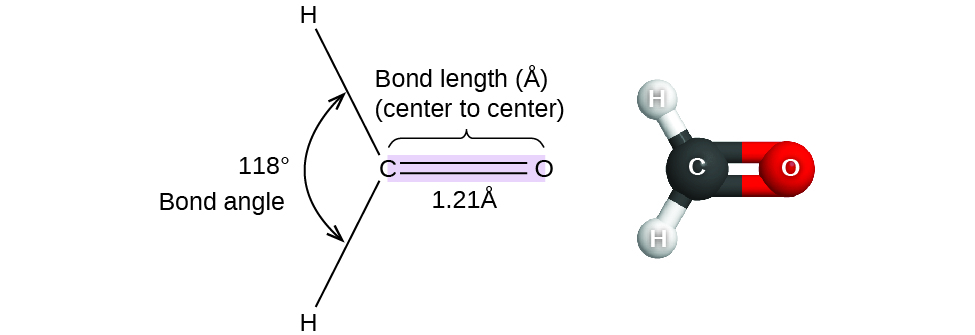
Thus far, we have used two-dimensional Lewis structures to represent molecules. Yet, molecular structure is really three-dimensional, and it is important to exist able to describe molecular bonds in terms of their distances, angles, and relative arrangements in infinite (Figure ane). A bond angle is the angle betwixt any 2 bonds that include a common atom, usually measured in degrees. A bond distance (or bond length) is the distance between the nuclei of 2 bonded atoms along the straight line joining the nuclei. Bond distances are measured in Ångstroms (one Å = x–10 m) or picometers (ane pm = 10–12 m, 100 pm = 1 Å).
VSEPR Theory
Valence shell electron-pair repulsion theory (VSEPR theory) enables u.s.a. to predict the molecular structure, including guess bond angles effectually a primal atom, of a molecule from an examination of the number of bonds and lone electron pairs in its Lewis construction. The VSEPR model assumes that electron pairs in the valence shell of a central cantlet volition adopt an arrangement that minimizes repulsions between these electron pairs by maximizing the distance between them. The electrons in the valence shell of a central atom course either bonding pairs of electrons, located primarily between bonded atoms, or lone pairs. The electrostatic repulsion of these electrons is reduced when the various regions of high electron density assume positions every bit far from each other every bit possible.
VSEPR theory predicts the system of electron pairs around each central atom and, usually, the correct system of atoms in a molecule. We should understand, however, that the theory only considers electron-pair repulsions. Other interactions, such every bit nuclear-nuclear repulsions and nuclear-electron attractions, are also involved in the terminal arrangement that atoms adopt in a detail molecular structure.
Every bit a simple example of VSEPR theory, let us predict the structure of a gaseous BeF2 molecule. The Lewis structure of BeF2 (Effigy 2) shows only 2 electron pairs effectually the key beryllium atom. With two bonds and no lonely pairs of electrons on the central cantlet, the bonds are equally far apart equally possible, and the electrostatic repulsion between these regions of high electron density is reduced to a minimum when they are on contrary sides of the cardinal atom. The bond angle is 180° (Figure 2).

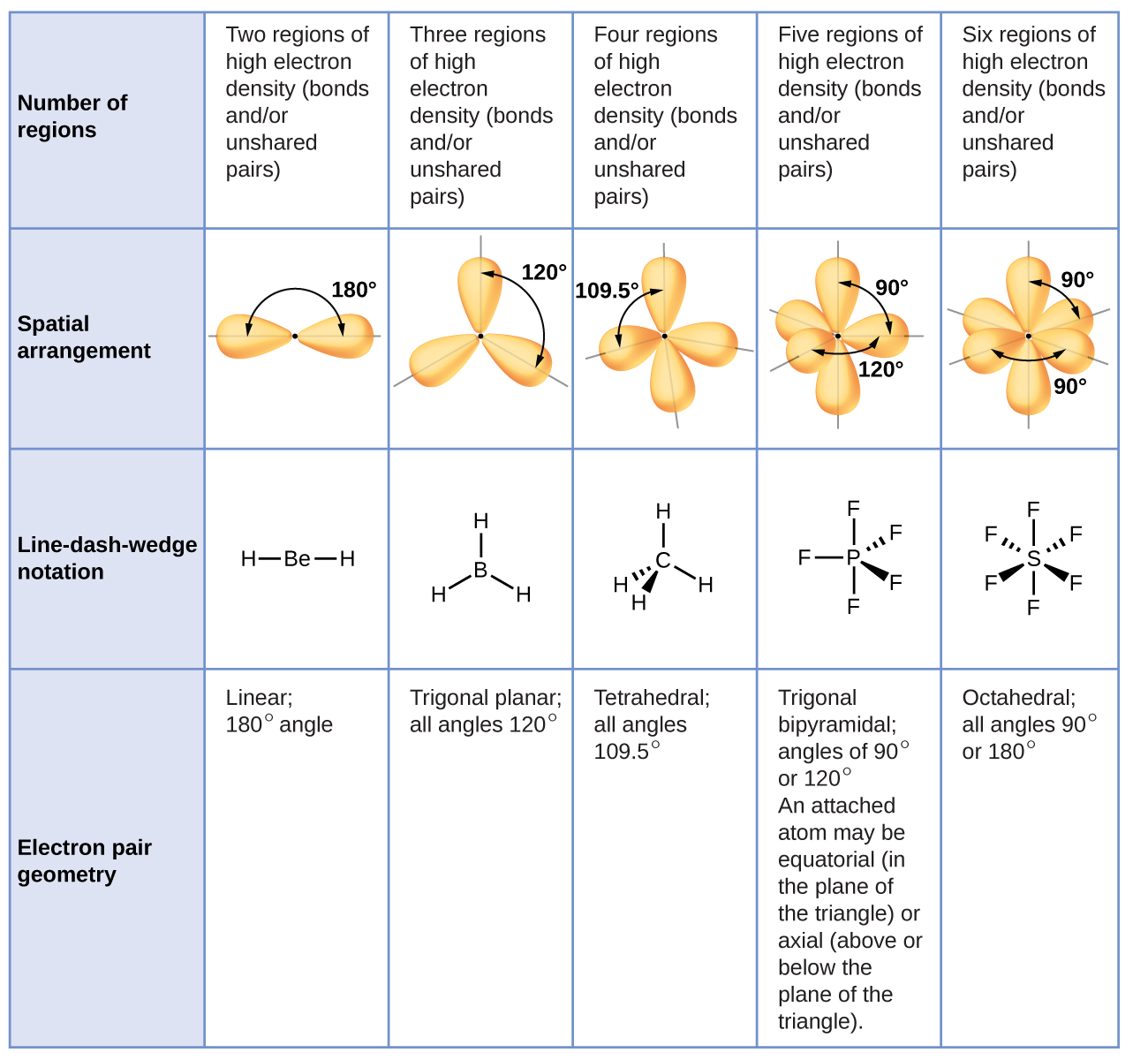
Effigy 3 illustrates this and other electron-pair geometries that minimize the repulsions among regions of loftier electron density (bonds and/or lone pairs). Two regions of electron density effectually a central atom in a molecule form a linear geometry; three regions form a trigonal planar geometry; 4 regions form a tetrahedral geometry; v regions grade a trigonal bipyramidal geometry; and half dozen regions course an octahedral geometry.
Electron-pair Geometry versus Molecular Construction
Information technology is important to annotation that electron-pair geometry around a key atom is not the same thing as its molecular structure. The electron-pair geometries shown in Effigy 3 draw all regions where electrons are located, bonds equally well as alone pairs. Molecular structure describes the location of the atoms, not the electrons.
We differentiate between these two situations by naming the geometry that includes all electron pairs the electron-pair geometry. The structure that includes only the placement of the atoms in the molecule is called the molecular structure. The electron-pair geometries will be the same as the molecular structures when there are no lonely electron pairs effectually the primal cantlet, but they will be different when there are lonely pairs present on the central atom.
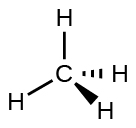
For case, the methyl hydride molecule, CH4, which is the major component of natural gas, has four bonding pairs of electrons around the central carbon atom; the electron-pair geometry is tetrahedral, as is the molecular construction (Figure 4). On the other hand, the ammonia molecule, NHthree, also has four electron pairs associated with the nitrogen cantlet, and thus has a tetrahedral electron-pair geometry. I of these regions, however, is a lone pair, which is not included in the molecular structure, and this solitary pair influences the shape of the molecule (Figure 5).
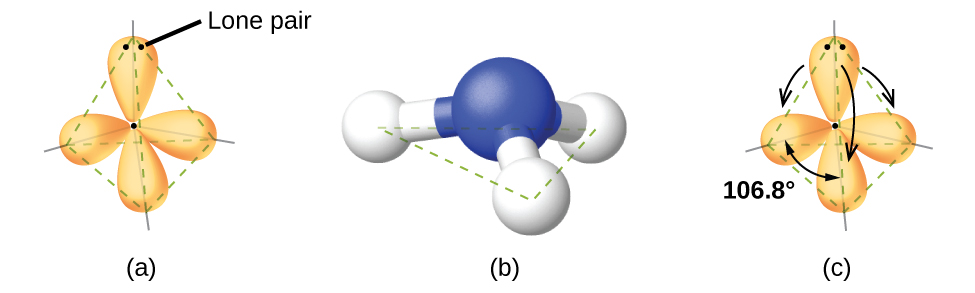
As seen in Figure 5, minor distortions from the ideal angles in Effigy 3 can result from differences in repulsion between various regions of electron density. VSEPR theory predicts these distortions past establishing an club of repulsions and an guild of the amount of infinite occupied past different kinds of electron pairs. The society of electron-pair repulsions from greatest to least repulsion is:
[latex]\text{lone pair-lone pair} > \text{alone pair-bonding pair} > \text{bonding pair-bonding pair}[/latex]
This order of repulsions determines the amount of space occupied by dissimilar regions of electrons. A solitary pair of electrons occupies a larger region of space than the electrons in a triple bail; in turn, electrons in a triple bond occupy more space than those in a double bond, so on. The order of sizes from largest to smallest is:
[latex]\text{lone pair} > \text{triple bond} > \text{double bond} > \text{single bail}[/latex]
Consider formaldehyde, H2CO, which is used as a preservative for biological and anatomical specimens (Figure 1). This molecule has regions of high electron density that consist of two unmarried bonds and 1 double bond. The basic geometry is trigonal planar with 120° bail angles, merely nosotros run across that the double bond causes slightly larger angles (121°), and the angle between the single bonds is slightly smaller (118°).
In the ammonia molecule, the three hydrogen atoms attached to the central nitrogen are not arranged in a flat, trigonal planar molecular structure, just rather in a three-dimensional trigonal pyramid (Figure five) with the nitrogen atom at the apex and the three hydrogen atoms forming the base. The ideal bond angles in a trigonal pyramid are based on the tetrahedral electron pair geometry. Once again, there are slight deviations from the platonic because lone pairs occupy larger regions of infinite than do bonding electrons. The H–Northward–H bond angles in NH3 are slightly smaller than the 109.5° angle in a regular tetrahedron (Figure 3) considering the lone pair-bonding pair repulsion is greater than the bonding pair-bonding pair repulsion (Figure five). Effigy 6 illustrates the ideal molecular structures, which are predicted based on the electron-pair geometries for various combinations of lonely pairs and bonding pairs.
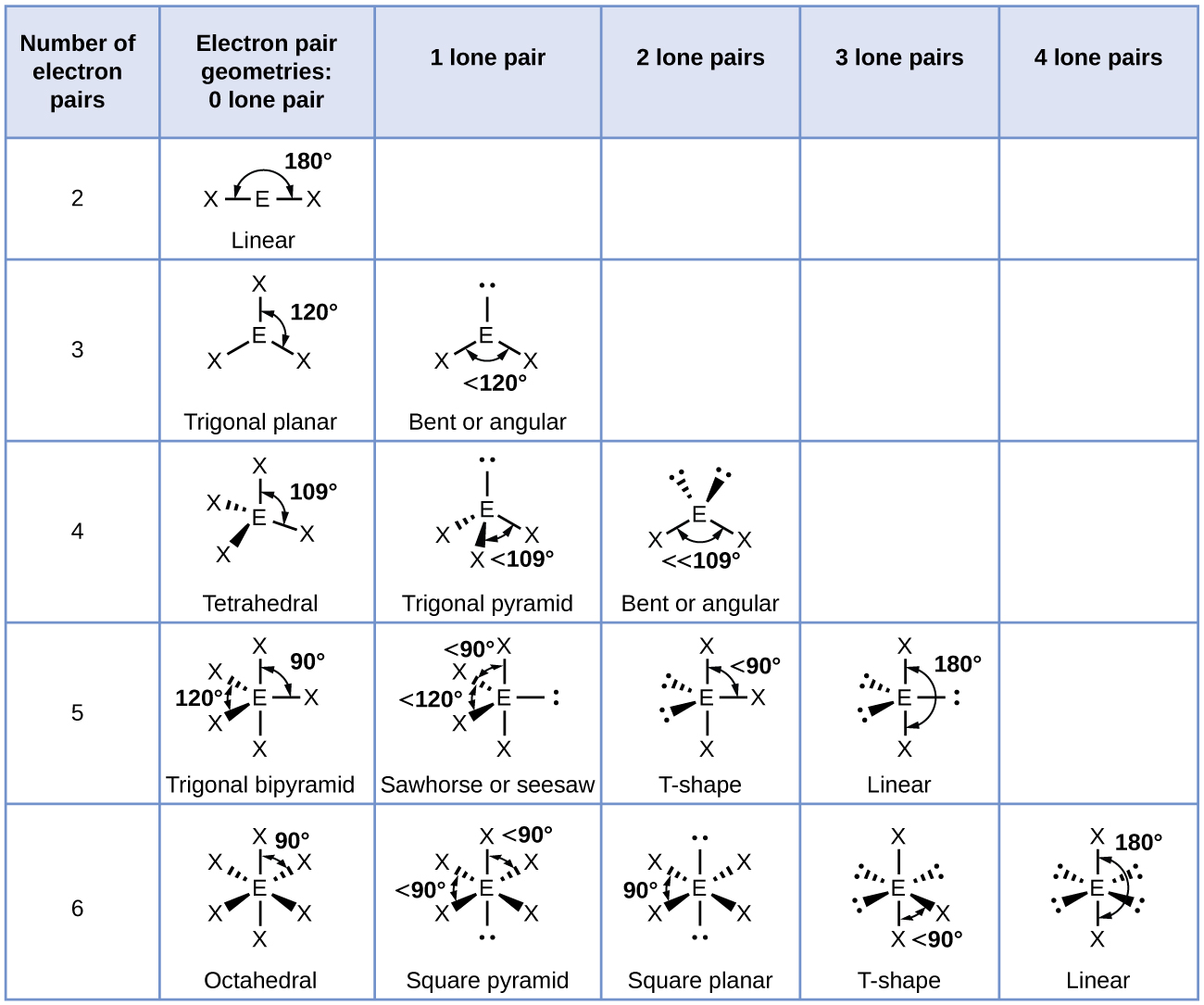
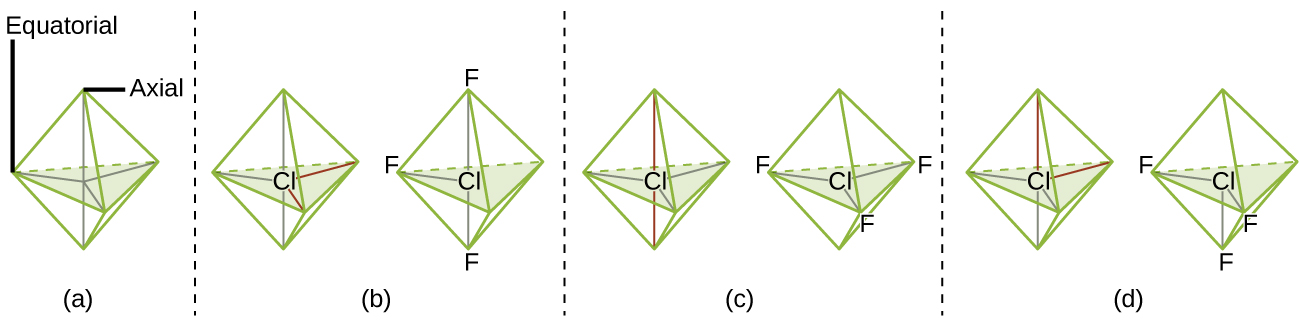
According to VSEPR theory, the terminal atom locations (Xs in Figure six) are equivalent within the linear, trigonal planar, and tetrahedral electron-pair geometries (the first iii rows of the tabular array). It does not matter which 10 is replaced with a lonely pair considering the molecules can be rotated to convert positions. For trigonal bipyramidal electron-pair geometries, even so, in that location are ii distinct X positions, as shown in Effigy 7: an axial position (if we hold a model of a trigonal bipyramid past the ii centric positions, nosotros have an axis effectually which nosotros can rotate the model) and an equatorial position (iii positions form an equator around the middle of the molecule). As shown in Figure 6, the centric position is surrounded by bond angles of 90°, whereas the equatorial position has more space available because of the 120° bond angles. In a trigonal bipyramidal electron-pair geometry, solitary pairs always occupy equatorial positions considering these more spacious positions can more easily accommodate the larger lone pairs.
Theoretically, we can come up with three possible arrangements for the three bonds and two alone pairs for the ClF3 molecule (Effigy 7). The stable construction is the one that puts the alone pairs in equatorial locations, giving a T-shaped molecular structure.
When a fundamental atom has two lonely electron pairs and four bonding regions, we have an octahedral electron-pair geometry. The two alone pairs are on opposite sides of the octahedron (180° autonomously), giving a square planar molecular structure that minimizes alone pair-alone pair repulsions (Effigy half-dozen).
Predicting Electron Pair Geometry and Molecular Construction
The following procedure uses VSEPR theory to determine the electron pair geometries and the molecular structures:
- Write the Lewis construction of the molecule or polyatomic ion.
- Count the number of regions of electron density (lone pairs and bonds) effectually the central cantlet. A single, double, or triple bond counts as one region of electron density.
- Identify the electron-pair geometry based on the number of regions of electron density: linear, trigonal planar, tetrahedral, trigonal bipyramidal, or octahedral (Effigy half dozen, start column).
- Use the number of solitary pairs to make up one's mind the molecular structure (Effigy 6). If more than than one arrangement of lonely pairs and chemical bonds is possible, choose the ane that will minimize repulsions, remembering that lone pairs occupy more space than multiple bonds, which occupy more space than single bonds. In trigonal bipyramidal arrangements, repulsion is minimized when every solitary pair is in an equatorial position. In an octahedral arrangement with two lone pairs, repulsion is minimized when the solitary pairs are on opposite sides of the central atom.
The post-obit examples illustrate the use of VSEPR theory to predict the molecular structure of molecules or ions that have no lone pairs of electrons. In this example, the molecular structure is identical to the electron pair geometry.
Example 1
Predicting Electron-pair Geometry and Molecular Structure: CO2 and BCl3
Predict the electron-pair geometry and molecular structure for each of the following:
(a) carbon dioxide, CO2, a molecule produced past the combustion of fossil fuels
(b) boron trichloride, BCl3, an important industrial chemical
Solution
(a) We write the Lewis structure of CO2 as:
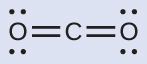
This shows us two regions of loftier electron density around the carbon atom—each double bond counts every bit 1 region, and there are no lone pairs on the carbon atom. Using VSEPR theory, we predict that the two regions of electron density suit themselves on opposite sides of the fundamental cantlet with a bond angle of 180°. The electron-pair geometry and molecular construction are identical, and COii molecules are linear.
(b) We write the Lewis structure of BCliii equally:
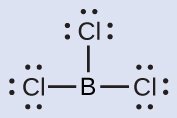
Thus we see that BCl3 contains three bonds, and there are no lone pairs of electrons on boron. The arrangement of iii regions of loftier electron density gives a trigonal planar electron-pair geometry. The B–Cl bonds prevarication in a plane with 120° angles betwixt them. BCl3 likewise has a trigonal planar molecular structure (Figure eight).
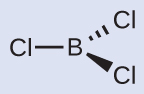
The electron-pair geometry and molecular structure of BClthree are both trigonal planar. Note that the VSEPR geometry indicates the right bond angles (120°), unlike the Lewis structure shown above.
Check Your Learning
Carbonate, CO3 2−, is a common polyatomic ion plant in diverse materials from eggshells to antacids. What are the electron-pair geometry and molecular construction of this polyatomic ion?
Answer:
The electron-pair geometry is trigonal planar and the molecular structure is trigonal planar. Due to resonance, all three C–O bonds are identical. Whether they are single, double, or an average of the ii, each bond counts as one region of electron density.
Case 2
Predicting Electron-pair Geometry and Molecular Structure: Ammonium
Two of the top 50 chemicals produced in the United States, ammonium nitrate and ammonium sulfate, both used every bit fertilizers, incorporate the ammonium ion. Predict the electron-pair geometry and molecular structure of the NHiv + cation.
Solution
Nosotros write the Lewis structure of NHiv + as:
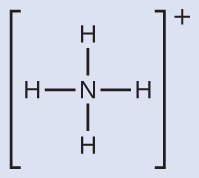
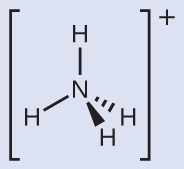
We can see that NHfour + contains four bonds from the nitrogen atom to hydrogen atoms and no alone pairs. We wait the four regions of high electron density to arrange themselves so that they indicate to the corners of a tetrahedron with the central nitrogen atom in the center (Figure 6). Therefore, the electron pair geometry of NHiv + is tetrahedral, and the molecular structure is also tetrahedral (Figure 9).
Bank check Your Learning
Identify a molecule with trigonal bipyramidal molecular structure.
Reply:
Any molecule with five electron pairs around the central atoms including no solitary pairs will be trigonal bipyramidal. PF5 is a mutual example.
The adjacent several examples illustrate the effect of lone pairs of electrons on molecular structure.
Example three
Predicting Electron-pair Geometry and Molecular Construction: Lone Pairs on the Central Atom
Predict the electron-pair geometry and molecular structure of a water molecule.
Solution
The Lewis structure of H2O indicates that at that place are 4 regions of loftier electron density around the oxygen atom: two alone pairs and two chemical bonds:
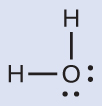
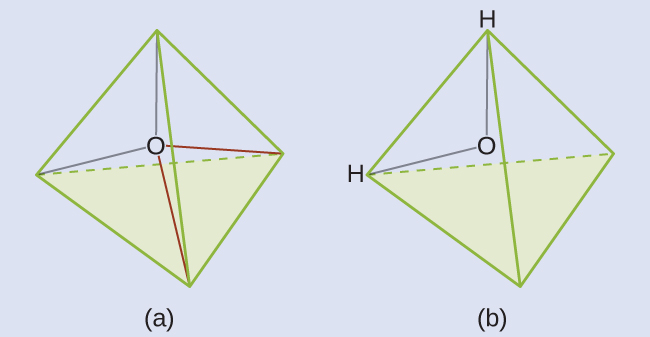
Nosotros predict that these four regions are arranged in a tetrahedral fashion (Effigy 10), equally indicated in Figure 6. Thus, the electron-pair geometry is tetrahedral and the molecular structure is aptitude with an angle slightly less than 109.five°. In fact, the bond angle is 104.v°.
Check Your Learning
The hydronium ion, H3O+, forms when acids are dissolved in water. Predict the electron-pair geometry and molecular construction of this cation.
Respond:
electron pair geometry: tetrahedral; molecular structure: trigonal pyramidal
Example 4
Predicting Electron-pair Geometry and Molecular Construction: SFfour
Sulfur tetrafluoride, SF4, is extremely valuable for the preparation of fluorine-containing compounds used as herbicides (i.e., SFiv is used every bit a fluorinating agent). Predict the electron-pair geometry and molecular structure of a SF4 molecule.
Solution
The Lewis construction of SF4 indicates v regions of electron density around the sulfur cantlet: one alone pair and four bonding pairs:
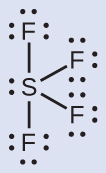
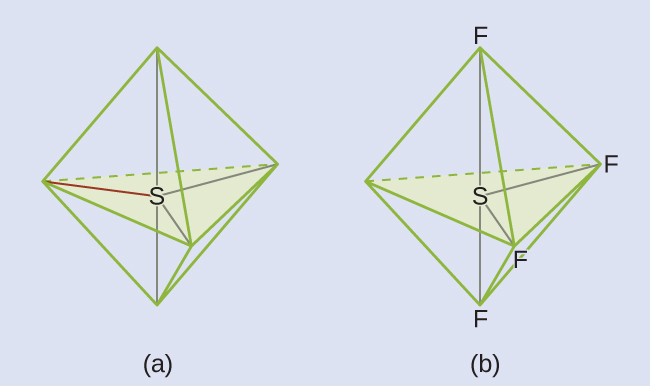
We look these five regions to adopt a trigonal bipyramidal electron-pair geometry. To minimize solitary pair repulsions, the solitary pair occupies one of the equatorial positions. The molecular structure (Figure eleven) is that of a seesaw (Effigy half dozen).
Check Your Learning
Predict the electron pair geometry and molecular structure for molecules of XeF2.
Reply:
The electron-pair geometry is trigonal bipyramidal. The molecular construction is linear.
Example 5
Predicting Electron-pair Geometry and Molecular Structure: XeF4
Of all the noble gases, xenon is the most reactive, frequently reacting with elements such every bit oxygen and fluorine. Predict the electron-pair geometry and molecular structure of the XeF4 molecule.
Solution
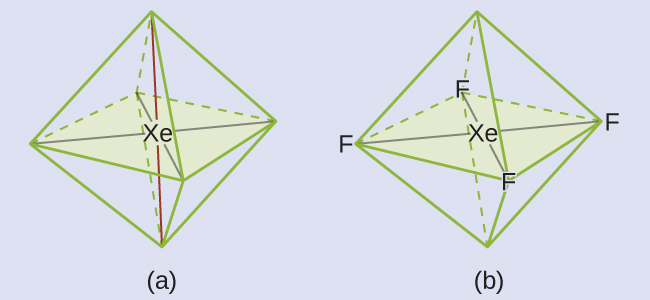
The Lewis structure of XeF4 indicates six regions of high electron density effectually the xenon cantlet: two solitary pairs and four bonds:
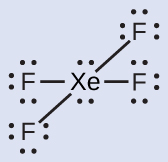
These half-dozen regions adopt an octahedral organization (Figure 6), which is the electron-pair geometry. To minimize repulsions, the lone pairs should be on opposite sides of the central atom (Figure 12). The five atoms are all in the same plane and take a square planar molecular structure.
Check Your Learning
In a certain molecule, the central atom has 3 lone pairs and two bonds. What will the electron pair geometry and molecular structure be?
Answer:
electron pair geometry: trigonal bipyramidal; molecular structure: linear
Molecular Construction for Multicenter Molecules
When a molecule or polyatomic ion has merely one central atom, the molecular construction completely describes the shape of the molecule. Larger molecules practice non have a unmarried central atom, but are connected by a chain of interior atoms that each possess a "local" geometry. The mode these local structures are oriented with respect to each other also influences the molecular shape, but such considerations are largely beyond the telescopic of this introductory discussion. For our purposes, nosotros will only focus on determining the local structures.
Example 6
Predicting Structure in Multicenter Molecules
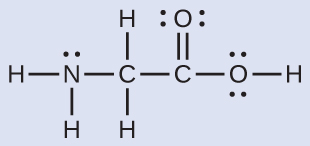
The Lewis structure for the simplest amino acid, glycine, HiiNCHtwoCO2H, is shown here. Predict the local geometry for the nitrogen atom, the 2 carbon atoms, and the oxygen atom with a hydrogen atom attached:
Solution
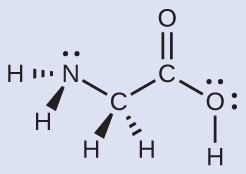
Consider each central atom independently. The electron-pair geometries:
- nitrogen––four regions of electron density; tetrahedral
- carbon (CHtwo)––four regions of electron density; tetrahedral
- carbon (COii)—iii regions of electron density; trigonal planar
- oxygen (OH)—four regions of electron density; tetrahedral
The local structures:
- nitrogen––3 bonds, 1 lone pair; trigonal pyramidal
- carbon (CH2)—iv bonds, no lone pairs; tetrahedral
- carbon (CO2)—three bonds (double bond counts as one bail), no lone pairs; trigonal planar
- oxygen (OH)—ii bonds, two lone pairs; bent (109°)
Bank check Your Learning
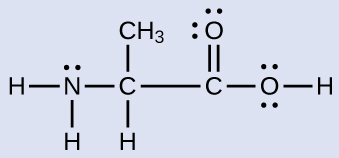
Another amino acrid is alanine, which has the Lewis structure shown here. Predict the electron-pair geometry and local structure of the nitrogen atom, the iii carbon atoms, and the oxygen cantlet with hydrogen attached:
Answer:
electron-pair geometries: nitrogen––tetrahedral; carbon (CH)—tetrahedral; carbon (CH3)—tetrahedral; carbon (CO2)—trigonal planar; oxygen (OH)—tetrahedral; local structures: nitrogen—trigonal pyramidal; carbon (CH)—tetrahedral; carbon (CHthree)—tetrahedral; carbon (COtwo)—trigonal planar; oxygen (OH)—bent (109°)

The molecular shape simulator lets you build various molecules and do naming their electron-pair geometries and molecular structures.
Example 7
Molecular Simulation
Using molecular shape simulator allows us to control whether bond angles and/or lone pairs are displayed by checking or unchecking the boxes nether "Options" on the right. We can also utilize the "Name" checkboxes at bottom-left to display or hide the electron pair geometry (chosen "electron geometry" in the simulator) and/or molecular structure (chosen "molecular shape" in the simulator).
Build the molecule HCN in the simulator based on the following Lewis structure:
[latex]\text{H} - \text{C} \equiv \text{Due north}[/latex]
Click on each bail blazon or lone pair at right to add together that group to the cardinal atom. In one case y'all have the consummate molecule, rotate it to examine the predicted molecular construction. What molecular structure is this?
Solution
The molecular construction is linear.
Check Your Learning
Build a more than complex molecule in the simulator. Identify the electron-group geometry, molecular structure, and bond angles. Then try to notice a chemical formula that would match the structure you lot have drawn.
Answer:
Answers volition vary. For instance, an atom with four single bonds, a double bond, and a alone pair has an octahedral electron-group geometry and a square pyramidal molecular structure. XeOFfour is a molecule that adopts this construction.
Molecular Polarity and Dipole Moment
Every bit discussed previously, polar covalent bonds connect 2 atoms with differing electronegativities, leaving i atom with a partial positive charge (δ+) and the other atom with a partial negative charge (δ–), equally the electrons are pulled toward the more electronegative atom. This separation of charge gives rising to a bond dipole moment. The magnitude of a bond dipole moment is represented past the Greek letter mu (µ) and is given by the formula shown hither, where Q is the magnitude of the partial charges (determined by the electronegativity deviation) and r is the distance between the charges:
[latex]\mu = \text{Qr}[/latex]
This bail moment tin can exist represented as a vector, a quantity having both management and magnitude (Figure xiii). Dipole vectors are shown as arrows pointing forth the bond from the less electronegative atom toward the more than electronegative atom. A small plus sign is drawn on the less electronegative terminate to point the partially positive end of the bond. The length of the arrow is proportional to the magnitude of the electronegativity difference between the two atoms.
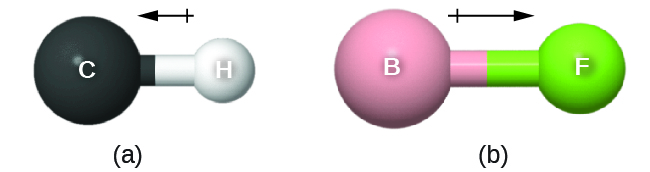
A whole molecule may also have a separation of charge, depending on its molecular structure and the polarity of each of its bonds. If such a charge separation exists, the molecule is said to exist a polar molecule (or dipole); otherwise the molecule is said to be nonpolar. The dipole moment measures the extent of net charge separation in the molecule equally a whole. We decide the dipole moment by adding the bond moments in three-dimensional space, taking into account the molecular structure.
For diatomic molecules, there is only i bond, so its bond dipole moment determines the molecular polarity. Homonuclear diatomic molecules such as Br2 and N2 accept no deviation in electronegativity, and so their dipole moment is nix. For heteronuclear molecules such equally CO, there is a small-scale dipole moment. For HF, there is a larger dipole moment because there is a larger difference in electronegativity.
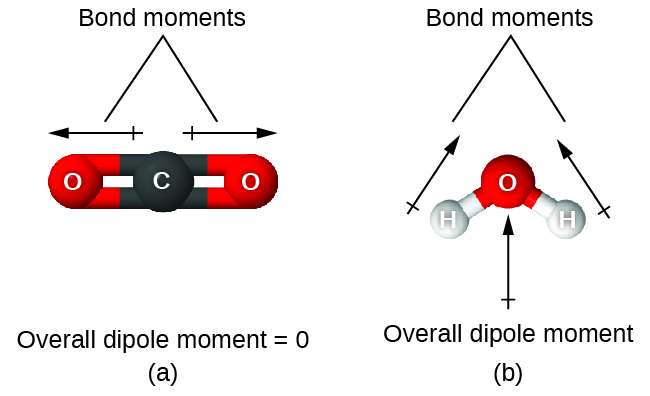
When a molecule contains more than 1 bond, the geometry must be taken into account. If the bonds in a molecule are arranged such that their bond moments cancel (vector sum equals zero), then the molecule is nonpolar. This is the situation in CO2 (Figure 14). Each of the bonds is polar, merely the molecule every bit a whole is nonpolar. From the Lewis construction, and using VSEPR theory, we determine that the COii molecule is linear with polar C=O bonds on opposite sides of the carbon atom. The bond moments cancel because they are pointed in opposite directions. In the case of the water molecule (Figure fourteen), the Lewis structure again shows that in that location are ii bonds to a central atom, and the electronegativity deviation again shows that each of these bonds has a nonzero bail moment. In this case, yet, the molecular structure is bent because of the alone pairs on O, and the 2 bail moments do not cancel. Therefore, water does accept a net dipole moment and is a polar molecule (dipole).
The OCS molecule has a construction similar to CO2, just a sulfur atom has replaced one of the oxygen atoms. To determine if this molecule is polar, nosotros depict the molecular structure. VSEPR theory predicts a linear molecule:
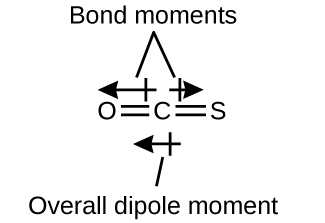
The C-O bail is considerably polar. Although C and S accept very like electronegativity values, S is slightly more electronegative than C, and so the C-Due south bail is just slightly polar. Because oxygen is more electronegative than sulfur, the oxygen end of the molecule is the negative end.
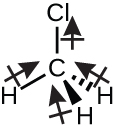
Chloromethane, CH3Cl, is another example of a polar molecule. Although the polar C–Cl and C–H bonds are bundled in a tetrahedral geometry, the C–Cl bonds take a larger bail moment than the C–H bond, and the bond moments do not completely cancel each other. All of the dipoles have a downward component in the orientation shown, since carbon is more than electronegative than hydrogen and less electronegative than chlorine:
When we examine the highly symmetrical molecules BFiii (trigonal planar), CH4 (tetrahedral), PF5 (trigonal bipyramidal), and SFsix (octahedral), in which all the polar bonds are identical, the molecules are nonpolar. The bonds in these molecules are arranged such that their dipoles cancel. However, just because a molecule contains identical bonds does not mean that the dipoles will always abolish. Many molecules that have identical bonds and alone pairs on the cardinal atoms have bail dipoles that practise not cancel. Examples include H2Due south and NH3. A hydrogen atom is at the positive end and a nitrogen or sulfur atom is at the negative end of the polar bonds in these molecules:

To summarize, to exist polar, a molecule must:
- Comprise at least one polar covalent bond.
- Have a molecular construction such that the sum of the vectors of each bond dipole moment does not cancel.
Properties of Polar Molecules
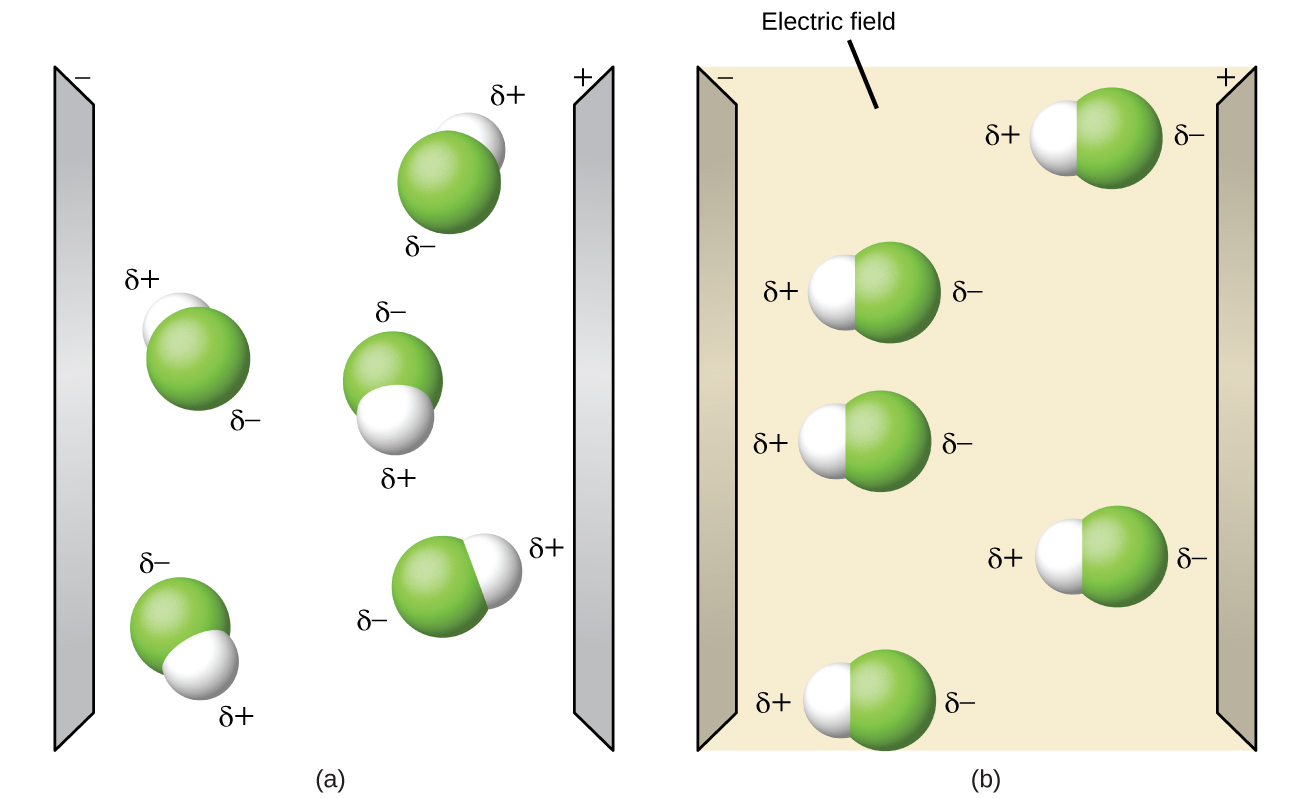
Polar molecules tend to marshal when placed in an electrical field with the positive end of the molecule oriented toward the negative plate and the negative end toward the positive plate (Figure xv). Nosotros tin use an electrically charged object to attract polar molecules, simply nonpolar molecules are non attracted. Also, polar solvents are better at dissolving polar substances, and nonpolar solvents are better at dissolving nonpolar substances.
The molecule polarity simulation provides many ways to explore dipole moments of bonds and molecules.
Case viii
Polarity Simulations
Open the molecule polarity simulation and select the "Three Atoms" tab at the top. This should display a molecule ABC with three electronegativity adjustors. You tin display or hide the bond moments, molecular dipoles, and partial charges at the right. Turning on the Electric Field will show whether the molecule moves when exposed to a field, similar to Figure xv.
Use the electronegativity controls to determine how the molecular dipole will look for the starting bent molecule if:
(a) A and C are very electronegative and B is in the middle of the range.
(b) A is very electronegative, and B and C are non.
Solution
(a) Molecular dipole moment points immediately between A and C.
(b) Molecular dipole moment points forth the A–B bond, toward A.
Check Your Learning
Make up one's mind the partial charges that volition requite the largest possible bond dipoles.
Answer:
The largest bond moments will occur with the largest fractional charges. The two solutions in a higher place correspond how unevenly the electrons are shared in the bail. The bail moments volition exist maximized when the electronegativity difference is greatest. The controls for A and C should be set to one farthermost, and B should be set to the reverse extreme. Although the magnitude of the bail moment will not alter based on whether B is the about electronegative or the to the lowest degree, the direction of the bail moment will.
Key Concepts and Summary
VSEPR theory predicts the three-dimensional arrangement of atoms in a molecule. Information technology states that valence electrons volition presume an electron-pair geometry that minimizes repulsions between areas of high electron density (bonds and/or lonely pairs). Molecular construction, which refers merely to the placement of atoms in a molecule and not the electrons, is equivalent to electron-pair geometry only when there are no alone electron pairs around the key atom. A dipole moment measures a separation of charge. For one bond, the bail dipole moment is determined by the difference in electronegativity between the two atoms. For a molecule, the overall dipole moment is determined by both the individual bond moments and how these dipoles are arranged in the molecular structure. Polar molecules (those with an appreciable dipole moment) collaborate with electric fields, whereas nonpolar molecules do not.
Chemistry Cease of Chapter Exercises
- Explain why the HOH molecule is bent, whereas the HBeH molecule is linear.
- What characteristic of a Lewis structure can be used to tell if a molecule's (or ion's) electron-pair geometry and molecular structure will be identical?
- Explain the difference between electron-pair geometry and molecular construction.
- Why is the H–N–H angle in NH3 smaller than the H–C–H bail angle in CHfour? Why is the H–N–H angle in NH4 + identical to the H–C–H bond angle in CHiv?
- Explain how a molecule that contains polar bonds can exist nonpolar.
- As a general rule, MXn molecules (where M represents a central atom and X represents terminal atoms; north = two – v) are polar if there is one or more than lone pairs of electrons on Grand. NH3 (Grand = N, X = H, due north = 3) is an example. There are two molecular structures with lonely pairs that are exceptions to this rule. What are they?
- Predict the electron pair geometry and the molecular construction of each of the following molecules or ions:
(a) SF6
(b) PCl5
(c) BeH2
(d) CH3 +
- Identify the electron pair geometry and the molecular structure of each of the following molecules or ions:
(a) IFvi +
(b) CFfour
(c) BFiii
(d) SiFv −
(east) BeCl2
- What are the electron-pair geometry and the molecular structure of each of the post-obit molecules or ions?
(a) ClFv
(b) ClO2 −
(c) TeClfour two−
(d) PCl3
(due east) SeF4
(f) PH2 −
- Predict the electron pair geometry and the molecular structure of each of the post-obit ions:
(a) HthreeO+
(b) PCl4 −
(c) SnClthree −
(d) BrCl4 −
(e) ICl3
(f) XeF4
(g) SFii
- Identify the electron pair geometry and the molecular structure of each of the following molecules:
(a) ClNO (Due north is the central atom)
(b) CS2
(c) CltwoCO (C is the primal cantlet)
(d) CliiSO (South is the central atom)
(e) SotwoFtwo (S is the key cantlet)
(f) XeO2Fii (Xe is the central atom)
(thou) ClOFii+ (Cl is the central atom)
- Predict the electron pair geometry and the molecular structure of each of the post-obit:
(a) IOF5 (I is the central atom)
(b) POCl3 (P is the cardinal cantlet)
(c) CltwoSeO (Se is the primal atom)
(d) ClSO+ (S is the central atom)
(e) F2And then (S is the central atom)
(f) NO2 −
(g) SiOiv 4−
- Which of the following molecules and ions incorporate polar bonds? Which of these molecules and ions have dipole moments?
(a) ClFv
(b) ClO2 −
(c) TeCliv 2−
(d) PCl3
(e) SeF4
(f) PHtwo −
(g) XeF2
- Which of these molecules and ions incorporate polar bonds? Which of these molecules and ions have dipole moments?
(a) H3O+
(b) PCl4 −
(c) SnCl3 −
(d) BrCl4 −
(e) IClthree
(f) XeF4
(g) SF2
- Which of the following molecules take dipole moments?
(a) CS2
(b) SeS2
(c) CCliiF2
(d) PCl3 (P is the central atom)
(e) ClNO (N is the central cantlet)
- Identify the molecules with a dipole moment:
(a) SFiv
(b) CFiv
(c) Cl2CCBrtwo
(d) CH3Cl
(eastward) H2CO
- The molecule XF3 has a dipole moment. Is 10 boron or phosphorus?
- The molecule XCl2 has a dipole moment. Is 10 beryllium or sulfur?
- Is the Cl2BBCl2 molecule polar or nonpolar?
- There are three possible structures for PCl2F3 with phosphorus as the key atom. Describe them and hash out how measurements of dipole moments could help distinguish among them.
- Describe the molecular structure around the indicated atom or atoms:
(a) the sulfur atom in sulfuric acrid, HiiSO4 [(HO)2Sotwo]
(b) the chlorine atom in chloric acid, HClO3 [HOClOii]
(c) the oxygen atom in hydrogen peroxide, HOOH
(d) the nitrogen atom in nitric acid, HNOthree [HONO2]
(eastward) the oxygen atom in the OH group in nitric acid, HNOthree [HONO2]
(f) the central oxygen atom in the ozone molecule, O3
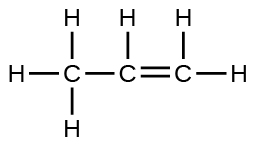
(g) each of the carbon atoms in propyne, CHiiiCCH
(h) the carbon atom in Freon, CCl2F2
(i) each of the carbon atoms in allene, H2CCCHii
- Draw the Lewis structures and predict the shape of each compound or ion:
(a) CO2
(b) NO2 −
(c) SO3
(d) Thenthree 2−
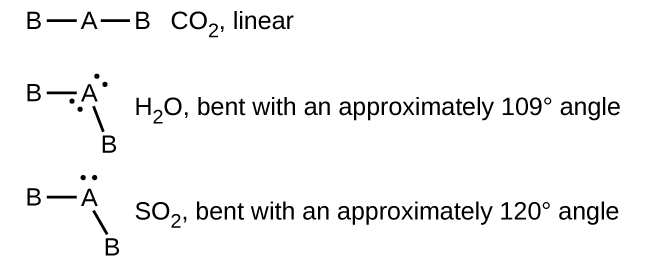
- A molecule with the formula AB2, in which A and B correspond dissimilar atoms, could accept i of three dissimilar shapes. Sketch and name the three different shapes that this molecule might have. Give an example of a molecule or ion for each shape.
- A molecule with the formula AB3, in which A and B represent different atoms, could take i of three unlike shapes. Sketch and name the three different shapes that this molecule might take. Give an instance of a molecule or ion that has each shape.
- Draw the Lewis electron dot structures for these molecules, including resonance structures where appropriate:
(a) CSthree 2−
(b) CS2
(c) CS
(d) predict the molecular shapes for CS3 2− and CS2 and explain how you arrived at your predictions
- What is the molecular structure of the stable form of FNO2? (North is the fundamental cantlet.)
- A compound with a molar mass of well-nigh 42 g/mol contains 85.vii% carbon and fourteen.iii% hydrogen. What is its molecular structure?
- Use the simulation to perform the post-obit exercises for a two-atom molecule:
(a) Adjust the electronegativity value then the bail dipole is pointing toward B. Then determine what the electronegativity values must be to switch the dipole and so that it points toward A.
(b) With a partial positive charge on A, turn on the electric field and draw what happens.
(c) With a minor partial negative charge on A, turn on the electrical field and describe what happens.
(d) Reset all, and so with a large partial negative charge on A, plough on the electric field and describe what happens.
- Use the simulation to perform the following exercises for a real molecule. You may demand to rotate the molecules in 3 dimensions to come across sure dipoles.
(a) Sketch the bond dipoles and molecular dipole (if whatever) for O3. Explain your observations.
(b) Look at the bond dipoles for NH3. Use these dipoles to predict whether Due north or H is more electronegative.
(c) Predict whether there should be a molecular dipole for NH3 and, if so, in which management it will betoken. Check the molecular dipole box to test your hypothesis.
- Use the Molecule Shape simulator to build a molecule. Starting with the key cantlet, click on the double bond to add ane double bail. Then add together 1 single bond and 1 lone pair. Rotate the molecule to observe the complete geometry. Name the electron group geometry and molecular structure and predict the bail angle. And then click the check boxes at the bottom and right of the simulator to check your answers.
- Utilise the Molecule Shape simulator to explore real molecules. On the Real Molecules tab, select H2O. Switch between the "existent" and "model" modes. Explicate the divergence observed.
- Use the Molecule Shape simulator to explore real molecules. On the Real Molecules tab, select "model" mode and S2O. What is the model bond bending? Explain whether the "existent" bond bending should exist larger or smaller than the ideal model angle.
Glossary
- centric position
- location in a trigonal bipyramidal geometry in which there is another atom at a 180° angle and the equatorial positions are at a 90° angle
- bond angle
- angle betwixt any ii covalent bonds that share a common atom
- bond distance
- (besides, bond length) distance betwixt the nuclei of ii bonded atoms
- bond dipole moment
- separation of accuse in a bond that depends on the departure in electronegativity and the bond distance represented by fractional charges or a vector
- dipole moment
- property of a molecule that describes the separation of charge adamant by the sum of the individual bond moments based on the molecular construction
- electron-pair geometry
- organisation around a key atom of all regions of electron density (bonds, alone pairs, or unpaired electrons)
- equatorial position
- one of the three positions in a trigonal bipyramidal geometry with 120° angles betwixt them; the centric positions are located at a 90° angle
- linear
- shape in which two outside groups are placed on opposite sides of a fundamental atom
- molecular structure
- construction that includes only the placement of the atoms in the molecule
- octahedral
- shape in which six exterior groups are placed around a central cantlet such that a three-dimensional shape is generated with iv groups forming a square and the other two forming the apex of ii pyramids, one above and one below the square plane
- polar molecule
- (also, dipole) molecule with an overall dipole moment
- tetrahedral
- shape in which iv outside groups are placed around a central atom such that a three-dimensional shape is generated with iv corners and 109.5° angles betwixt each pair and the central cantlet
- trigonal bipyramidal
- shape in which v outside groups are placed around a central atom such that three class a flat triangle with 120° angles between each pair and the fundamental cantlet, and the other two grade the noon of two pyramids, one to a higher place and 1 below the triangular airplane
- trigonal planar
- shape in which three outside groups are placed in a flat triangle around a key atom with 120° angles between each pair and the fundamental atom
- valence trounce electron-pair repulsion theory (VSEPR)
- theory used to predict the bond angles in a molecule based on positioning regions of loftier electron density every bit far apart as possible to minimize electrostatic repulsion
- vector
- quantity having magnitude and direction
Solutions
Answers to Chemistry Stop of Chapter Exercises
1. The placement of the two sets of unpaired electrons in water forces the bonds to assume a tetrahedral arrangement, and the resulting HOH molecule is aptitude. The HBeH molecule (in which Be has only two electrons to bail with the two electrons from the hydrogens) must accept the electron pairs as far from one another equally possible and is therefore linear.
three. Space must be provided for each pair of electrons whether they are in a bond or are present as alone pairs. Electron-pair geometry considers the placement of all electrons. Molecular structure considers only the bonding-pair geometry.
v. Equally long equally the polar bonds are compensated (for example. two identical atoms are constitute directly across the central atom from i another), the molecule tin can be nonpolar.
vii. (a) Both the electron geometry and the molecular structure are octahedral.
(b) Both the electron geometry and the molecular construction are trigonal bipyramid.
(c) Both the electron geometry and the molecular structure are linear.
(d) Both the electron geometry and the molecular structure are trigonal planar.
ix. (a) electron-pair geometry: octahedral, molecular structure: square pyramidal; (b) electron-pair geometry: tetrahedral, molecular construction: bent; (c) electron-pair geometry: octahedral, molecular structure: square planar; (d) electron-pair geometry: tetrahedral, molecular structure: trigonal pyramidal; (e) electron-pair geometry: trigonal bypyramidal, molecular construction: seesaw; (f) electron-pair geometry: tetrahedral, molecular construction: bent (109°)
11. (a) electron-pair geometry: trigonal planar, molecular construction: aptitude (120°); (b) electron-pair geometry: linear, molecular construction: linear; (c) electron-pair geometry: trigonal planar, molecular construction: trigonal planar; (d) electron-pair geometry: tetrahedral, molecular structure: trigonal pyramidal; (e) electron-pair geometry: tetrahedral, molecular structure: tetrahedral; (f) electron-pair geometry: trigonal bipyramidal, molecular structure: seesaw; (g) electron-pair geometry: tetrahedral, molecular structure: trigonal pyramidal
thirteen. All of these molecules and ions contain polar bonds. Only ClF5, ClOtwo −, PClthree, SeF4, and PHii − have dipole moments.
15.SeS2, CCliiF2, PClthree, and ClNO all have dipole moments.
17. P
19. nonpolar
21. (a) tetrahedral; (b) trigonal pyramidal; (c) bent (109°); (d) trigonal planar; (e) bent (109°); (f) aptitude (109°); (g) CHthreeCCH tetrahedral, CHthree CCH linear; (h) tetrahedral; (i) H2CCCH2 linear; H2 CCCHii trigonal planar
23.
25.
(a)
 ;
;
(b)
 ;
;
(c)
 ;
;
(d) CS3 two− includes three regions of electron density (all are bonds with no lone pairs); the shape is trigonal planar; CStwo has only two regions of electron density (all bonds with no solitary pairs); the shape is linear
27. The Lewis construction is fabricated from three units, but the atoms must exist rearranged:
29. The molecular dipole points away from the hydrogen atoms.
31. The structures are very similar. In the model fashion, each electron group occupies the same amount of space, then the bond angle is shown as 109.five°. In the "real" way, the alone pairs are larger, causing the hydrogens to be compressed. This leads to the smaller angle of 104.5°.
Source: https://opentextbc.ca/chemistry/chapter/7-6-molecular-structure-and-polarity/
0 Response to "what does the 3d molecular drawing bh3 molecular geometry"
Post a Comment