save ai drawing as a 3d object
Illustrator to After Furnishings: 3D Logo Workflow
Past Kristian Gabriel, Adobe Expert/ACI
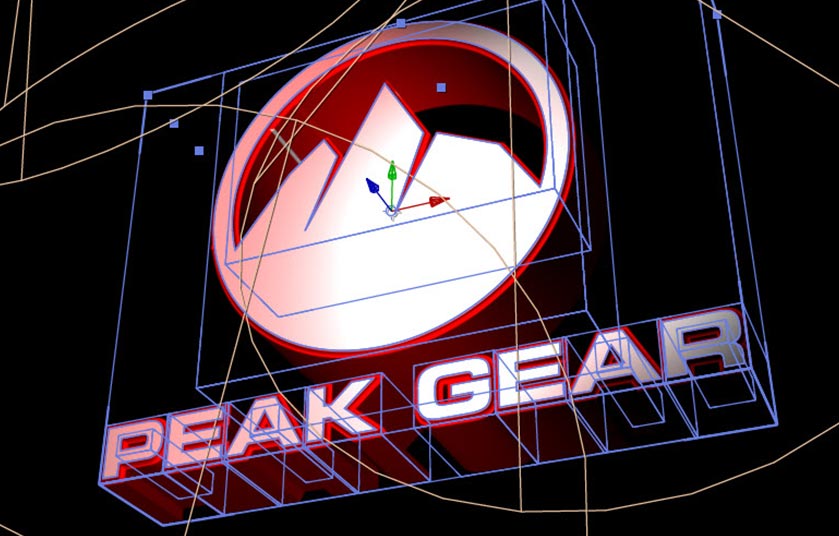
The power to take a custom vector logo designed in Illustrator and bring it to After Effects for animation is invaluable. Animated network Idents, logos, lower thirds - the applications are endless. In this quick, downwards and dirty guide, let us look at the best ways to become your logos from Illustrator to Subsequently Furnishings and prep them to be blithe in 3D.
Looking to acquire Adobe Illutrator or Later on Effects?. We run some of the best Illustrator workshops and Subsequently Furnishings workshops in Los Angeles, plus our trainers can deliver onsite preparation right across the country. Obtain a quote for onsite Adobe training.
Pace 01 - Prep & Save Your Logo In Adobe Illustrator
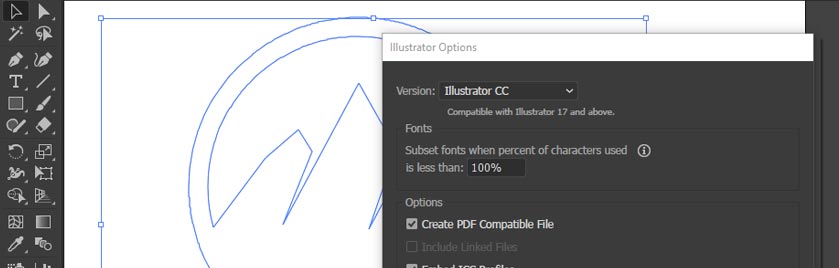
Before yous can import your logo into Subsequently Effects, it needs to exist prepped and saved in a proper vector format. This guide assumes that you have either designed your vector logo in Illustrator, or you accept imported a vector logo into Illustrator. Note: Raster formats similar JPEGs, TIFFs, PNGs, GIFs and others cannot be used with this method.
Once you lot've adamant that your logo is finished, make information technology a contrasting colour based on your After Furnishings composition background colour. If your groundwork is black, y'all tin make your logo white and if your background is white, make your logo black. This is mainly then you can run across your logo when imported into the timeline. You lot tin can always change color later on. Now, all you need to do is simply salve your logo equally a native '.ai' file.
This is the official Adobe Illustrator project file format and is the best file for bringing into programs similar After Furnishings. As for the writing of this article, you can alternatively apply EPS files (Encapsulated Post Script) and vector PDF files. At present, to save your logo, get to FILE > Salvage AS... and make sure Adobe Illustrator (*.ai), Adobe EPS (*.eps) or Adobe PDF (*.pdf) is selected. Now save your project file.
Footstep 02 - Importing & Prepping Your Logo for 3D
After saving your logo, open After Effects and utilise the standard FILE > IMPORT > FILE... to bring in your logo as an Adobe Illustrator file. At this point, y'all need an After Effects composition to put it in. If you already accept i created, go ahead and elevate your logo from the project window to the timeline. If yous do not have a composition created nevertheless, create one now at the size and framerate of your delivery project and so drag your logo from the project window to your timeline.
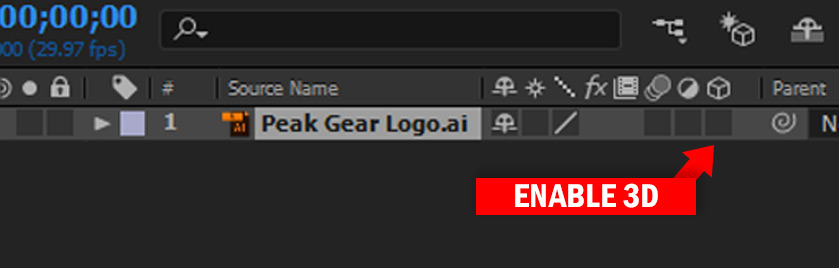
At present, to prepare your logo layer and make it ready for 3d you need to practice two things:
- Enable your logo layer for 3D in your timeline past clicking on the Enable 3D checkbox. And...
- Right-click your logo layer in the timeline and select CREATE SHAPES FROM VECTOR LAYER.
Create Shapes From Vector Layer properly converts your vector layer from a standard vector to a vector generated shape that Afterward Effects can better dispense, giving information technology 3D properties when you are in the correct way. You volition now detect y'all have ii (two) logos in your timeline. One shape layer version and one Illustrator .ai version that is disabled. At this point, you tin delete the .ai layer to reduce clutter.
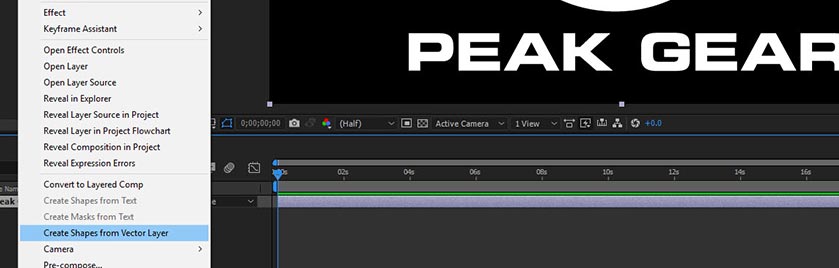
Step 03 - 3D Conversion
If you are in your limerick or timeline window, apply Control or Control + G or go to COMPOSITION > COMPOSITION SETTINGS... and click on the 3D Renderer tab equally pictured higher up. By default, y'all will come across that Later on Effects is in a mode called Archetype 3D. Archetype 3D is the traditional After Effects editing mode and primarily focuses on editing 2D Graphics in 2D or 2d Graphics in 3D space. Unfortunately, this will non allow you to piece of work with "existent" 3D objects without a 3rd party plugin like Element 3D. To remedy this, we have two additional rendering modes we can piece of work with Ray-Traced 3D and Cinema 4D. Each of these rendering modes uses dissimilar math to enable the extrusions of 3D objects in 3D space. Both enable a lot of 3D functionality but each will disable a sure number of Later Effects functions and features. For example:
- Movie theater 4D Mode WILL DISABLE : blending modes, track mattes, layer styles, masks and effects on continuously rasterized layers, text and shape layers and collapsed 3D precompositions. It will also disable underlying transparencies, low-cal transmission, adjustment lights, transparency and alphabetize refraction, the 'Accepts Shadows Only' function, motion blur and camera depth of field.
- RAY-TRACED mode WILL DISABLE : blending modes, track mattes, layer styles, masks and furnishings on continuously rasterized layers, tet and shape layers and complanate 3D precompositions. Ray-Traced mode volition as well disable underlying transparencies.
Cinema 4D is the newer renderer and offers a mostly faster and easier solution to you rendering procedure in some situations. Choose Movie theatre 4D as the renderer and then click 'OK'.
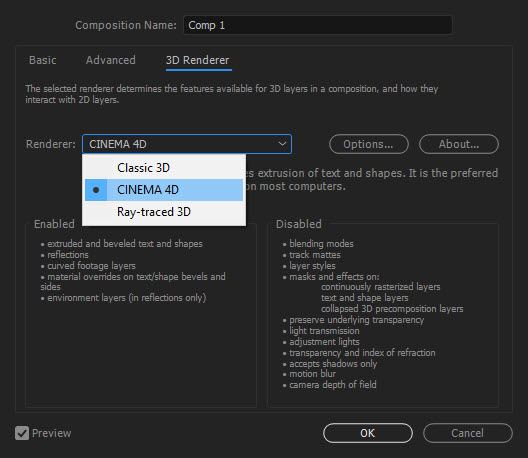
Stride 04 - 3D Logo Details & Additional Tweaks
Before you start making your logo 3D, add together a simple Indicate or Spot Lite and then that you lot can come across the extrusion properly. That'southward it! Now, to extrude your logo in 3D space, reveal the Geometry Options nether your 3D logo layer and increment Extrusion Depth. Other things you can play with is the type of Bevel Styles and Bevel Depth to make the edges of your text a little more than interesting. If you lot want modify color of the individual letters or pieces of your logo - go into your shape layer's Content Properties and you will be able to tweak color and a whole lot of other things!
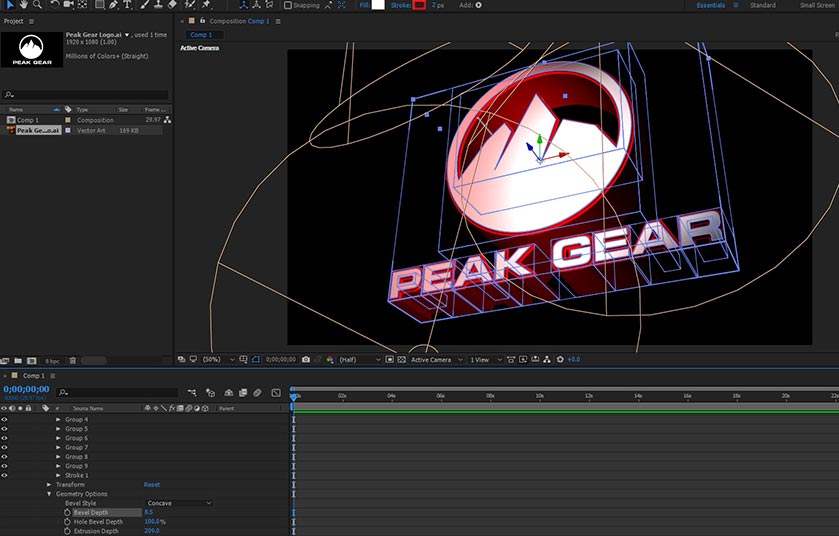
Alternatives to bringing in logos from Photoshop and other Apps
The following are alternative methods you can utilize if your logo was created in Photoshop, CorelDraw or whatsoever other graphic application.
- PHOTOSHOP METHOD: If yous take your logo in Photoshop, catechumen your logo to Paths (y'all tin can use the Brand Work Paths feature) and so y'all can go to EXPORT > PATHS TO ILLUSTRATOR... This will export your vector paths into an Illustrator Projection file. Then yous can fill paths and generally tweak your vector logo until its gear up for saving out to Afterward Effects.
- OTHER APPS: Using other apps similar Corel Describe - you tin can consign into an .EPS file for firsthand import into After Effects or fifty-fifty a .CDR (Corel Describe file) or .SVG (Scalable Vector file) - but these formats will accept to be loaded into Illustrator first and resaved as an .ai, .eps or .eps file.
Hopefully this wasn't besides crazy to absorb! Remember that if you lot want to delve deeper into these subjects and more, check out Grooming Connexion'south After Effects, Illustrator and Photoshop classes and boot camps and skilful luck with your own projects!
Source: https://www.trainingconnection.com/after-effects/lessons/illustrator-after-effects.php
0 Response to "save ai drawing as a 3d object"
Post a Comment