what would you change to make the brave new world a perfect scientific-techno utopia?
The time to come is the present projected," said Aldous Huxley. "Our notions of the hereafter have something of that significance which Freud attributes to our dreams. And not our notions of the future simply: our notions of the by as well. For if prophecy is an expression of our contemporary fears and wishes, then too, to a very nifty extent, is history."
Huxley'south well-nigh famous novel, Brave New Globe , was published in 1932, and the occasion of this seventy-fifth ceremony should pb us to wonder almost his peculiar description of how we sympathise the hereafter. Nosotros live in a time of biotechnological leaps forrard that have made the term "Dauntless New World" almost a reflex for commentators worried nosotros are rushing headlong toward a sterilized post-human order, engineered to joyless joy. It is easy to imagine that we see the shadows of our society in Huxley's vision of the future. Only could it exist that our insistence on seeing Huxley's book as an exceedingly successful prophecy actually prevents us from recognizing its real insight? Is there a way for u.s. to understand the book gratuitous of the great distorting influence of our ain times?
Discussed in this article
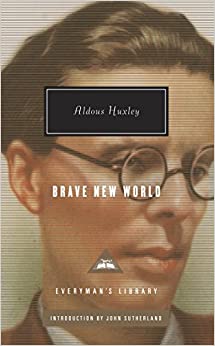
We can do that merely by reading the book on its ain terms, as its first readers did, and past letting ourselves be guided past the literary, scientific, and cultural critics of Huxley'due south day. In doing so, we may glimpse afresh something of the meaning of Dauntless New World in its writer's mind and fourth dimension.
"Progress is Lovely, Isn't It?"
Huxley's vision of the time to come begins with a tour of the Fundamental London Hatchery and Workout Center, in the year of stability a.f. 632 (After Ford). "Viviparous" reproduction, that shameful underground of the past, has been replaced with manufacture; here the eggs are selected from disembodied ovaries, mixed in civilization with the sperm, and incubated in a clean, sterile, efficient environs overseen by technicians — "the baroque example," equally ane critic has noted, "of a production supervising a production line." The embryos are designated into v castes, and while the elite Alphas and Betas each come up from one unique embryo per egg, the Gammas, Deltas, and Epsilons are cloned ("bokanovskified") into as many as xc-6 embryos per egg. "For in nature information technology takes thirty years for two hundred eggs to reach maturity. Simply our business organisation is to stabilize the population at this moment, hither and now. Dribbling out twins over a quarter of a century — what would be the use of that?"
Welcome to the World State, where "all men are physico-chemically equal" and "everybody's happy now." People are conditioned by genetic engineering, electric shocks, and hypnopaedic repetition to accept these and other mantras as the sum of their identities, to promote self-approbation and simple desires. Sexually, people are uniformly promiscuous — "everyone belongs to everyone else" — fugitive those neuroses rooted in repression or exclusive attachments. Erotic experimentation begins at six or 8 years old. Economically, the social club has subscribed so thoroughly to mass consumerism that the consumers themselves have been commodified. "Taught to acquire an infinity of gimcrack objects," as one early on reviewer said, they spend their labor mindlessly producing the things that in their leisure they mindlessly consume. And, every bit 1 grapheme explains, "if ever by some unlucky chance such a crevice of time should yawn in the solid substance of their distractions, at that place is e'er soma, succulent soma, half a gramme for a half-holiday, a gramme for a calendar week-end, two grammes for a trip to the gorgeous East, three for a nighttime eternity on the moon." A dream drug without side effects, soma assuages every injure or unmet need, from colorlessness to impotence to insecurity to chagrin, and all other "miseries of space and time."
An unholy alliance of industrial capitalist, fascist, communist, psychoanalytic, and pseudo-scientific ideologies has brought about the stop of history. The past is taboo — "History is bunk," as "Our Ford" and so eloquently said — and at that place is no futurity, because history's ends accept been accomplished. There is no hurting, deformity, offense, ache, or social discontent. Even death has no more sting: Children are acclimatized to the decease palaces from the age of eighteen months, encouraged to poke around and eat chocolate creams while the dying are ushered into oblivion on soma, watching sports and pornography on television set. Postmortem, the useful chemicals in every corpse are recovered in cremation to be used equally fertilizer. "Fine to call up we can continue existence socially useful fifty-fifty after we're dead," gloats one character. "Making plants grow."
There are a few remaining "barbarous reservations" not integrated into the World Land. When Bernard and Lenina, a couple of hatchery employees, travel on vacation to one such reservation in New United mexican states, their Siddhartha-similar see with age, disease, and death ends in a remarkable discovery. One fellow member of their civilization, left behind some twenty years before, has borne a son and raised him on the reservation. Bernard and Lenina take the woman and her grown son dorsum to London. "Fell John," equally he is dubbed, has heard the glories of the "Other Identify" from his mother all his life, and he is at first entranced. "O, wonder!" he says, with the same naïve irony as Shakespeare'southward Miranda. "How many goodly creatures are there here! How beauteous mankind is! O brave new world, that has such people in't!" Just when his mother, whose natural aging has fabricated her too grotesque for her own lodge, passes away in soma-induced delusions, he revolts. Retreating to a lonely haven, he is presently found out; in a blaze of torture and disgust, he and his ideals collapse in freakish self-destruction. Lenina, who despite all her conditioning can dimly feel a yearning for the other, greater world John tried to evidence her, is destroyed with him. It would seem to be the death of promise as well, but hope was never truly living in the World Land, where the "births" are every bit devoid of potential every bit the lives are of significance.
Rational Futures
The critical reception of Dauntless New World was largely chilly. Most reviewers were disgruntled or disgusted with what they saw equally unjustified alarmism. H. K. Wells was downright offended. "A author of the standing of Aldous Huxley has no right to betray the hereafter as he did in that volume," Wells said. In fact, Wells felt the bite of this betrayal personally — his own writings, particularly his 1923 novel Men Like Gods , had been Huxley'southward inspiration. Huxley told a friend in 1931 that he was "writing a novel most the time to come — on the horror of the Wellsian Utopia and a defection against it."
Wells is ofttimes considered the father of scientific discipline fiction. His long train of novels predicted, among other things, tanks, aerial warfare, and the atomic bomb; as J. B. S. Haldane said, "the very mention of the future suggests him." Although his earlier and most memorable piece of work explores the darker possibilities of scientific advocacy (in a 1940 preface to his 1908 novel The War in the Air , Wells said he wanted his epigraph to read "I told yous so. You damned fools."), in Huxley's heyday Wells was writing utopias teeming with technogadgetry and what George Orwell called "enlightened sunbathers." Rejecting Rousseau's noble savage and the romantic utopias of Coleridge and Wordsworth, he saw the Industrial Revolution and mod science as enduring and largely positive developments in homo's eternal conflict with pitiless nature, including his own. Men Like Gods is the story of a grouping of contemporary Englishmen accidentally transported into an alternate dimension of peaceful, passionless Utopians who are uncritically committed to scientific rationalism and the self-negating collectivist land. As the title suggests, this is Wells's idea of perfectible Man, achieved through communitarian ideals, technological enhancement, and an aggressive program of eugenics. The Utopians share their wisdom with the time-travelers, explaining how they put "the primordial fierce combativeness of the ancestral homo-ape" backside them. Only as man's intrinsic assailment had brought civilization to the brink of collapse, a cracking prophet saw the calorie-free. In "a dawn of new ideas," an elite group of researchers reordered guild until, finally annihilating the sources of strife, they accomplished a cooperative land with "no parliament, no politics, no private wealth, no business organisation competition, no police nor prisons, no lunatics, no defectives nor cripples," whose motto is "Our education is our government."
Huxley thought this vision preposterous. "Get rid of priests and kings, make Aeschylus and the differential calculus available to all, and the globe will get a paradise," he scoffed. Men Like Gods "annoyed me to the point of planning a parody, but when I started writing I found the idea of a negative Utopia then interesting that I forgot about Wells and launched into Dauntless New Earth."
Prior to Huxley'southward volume, however, another swell dystopia had bandage a scorching glare on totalitarian rationalism. Russian author Yevgeny Zamyatin'southward We depicts a technocratic OneState whose citizens are "Numbers" governed with absolute authority in a system where political and quantitative laws are fused. Zamyatin, the Russian editor of H. One thousand. Wells's novels, had at first supported the Bolshevik Revolution simply came nether burn down throughout the 1920s for his song criticism of the Soviet regime. His works were banned and he was arrested several times, and finally moved permanently to Paris in 1931. First released in English in 1924, We was not officially published in Russian until 1988 under glasnost. Some critics suggested Huxley had borrowed from or been heavily influenced past We. George Orwell — himself not particularly impressed with Brave New Earth, which he called a "brilliant caricature of the present" that "probably casts no light on the future" — even accused Huxley of plagiarism (a particularly strange charge since Orwell's ain 1984 was much more than directly influenced past We). Curious about information technology himself, Zamyatin learned through a mutual friend that Huxley had not read We before he published Brave New World, "which proves," he said, that "these ideas are in the air we breathe."
But near critics shared Wells's, not Zamyatin's, reaction to the book. "Equally prophecy it is merely fantastic," dismissed essayist Gerald Bullett. Wells's friend and fellow writer Wyndham Lewis called information technology "an unforgivable law-breaking to Progress." Marxist literary critic Granville Hicks began his review by asking, "With war in Asia, bankruptcy in Europe and starvation everywhere, what do you suppose Aldous Huxley is now worrying about?" and ended it with several personal attacks.
Economist Henry Hazlitt sarcastically remarked that "a piddling suffering, a little irrationality, a little division and chaos, are mayhap necessary ingredients of an ideal land, but in that location has probably never been a time when the world has not had an oversupply of them." J. B. Due south. Haldane's then-wife Charlotte penned a snide review for Nature, lament that Huxley's great-uncle Matthew Arnold, the bourgeois literary critic, had taken demonic possession of him, and that in any instance, "biology is itself likewise surprising to be actually amusing material for fiction." Even G. One thousand. Chesterton thought Huxley's book sadly laughable, observing that, "Notwithstanding grimly he may enjoy the present, he already definitely hates the time to come. And I merely differ from him in not assertive that there is any such time to come to hate."
The review by poet and novelist L. A. G. Strong perhaps best evinces the critics' general sense of disappointment for a promising writer's senseless retreat into a ludicrous future: "Mr. Huxley has been built-in too tardily. Seventy years agone, the keen powers of his listen would have been anchored to some mighty certitude, or to some equally mighty scientific denial of a certitude. Today he searches sky and earth for a Commandment, just searches in vain: and the lack of it reduces him, metaphorically speaking, to a human being standing beside a midden, shuddering and holding his nose."
Non anybody, all the same, dismissed Huxley's dystopia as nonsense. "Just biologists and philosophers will actually capeesh the full force of Mr. Huxley's remarkable book," wrote Joseph Needham, a Cambridge biochemist and embryologist. "For of course in the world at large, those persons, and there volition be many, who do non corroborate of his 'utopia,' will say, we can't believe all this, the biology is all incorrect, it couldn't happen. Unfortunately, what gives the biologist a sardonic smiling as he reads it, is the fact that the biology is perfectly right."
Huxley came from a famously scientific family unit. He was the grandson of the biologist T. H. Huxley, nicknamed "Darwin's Bulldog" for his early on untiring advancement for the theory of evolution; half-blood brother of Andrew Fielding Huxley, the 1963 Nobel laureate in physiology; and brother of Julian Huxley, a prominent geneticist. Aldous Huxley was besides sometime friends with J. B. S. Haldane and Bertrand Russell, who debated the futurity of scientific and technological progress in a 1923 exchange of essays (the subject of a recent exegesis in these pages by Charles T. Rubin ["Daedalus and Icarus Revisited," Spring 2005]).
While it was Haldane who get-go used the word ectogenesis to draw the notion of creating man life exterior the womb, the process of reproduction practiced in the World State's hatcheries, Huxley attributes the thought itself to Russell, at to the lowest degree figuratively. In his 1921 novel Crome Yellowish , Huxley has the character Scogan, an unflattering and barely veiled portrayal of Russell, imagine a future where "an impersonal generation will take the place of Nature's hideous system. In vast state incubators, rows upon rows of gravid bottles volition supply the world with the population information technology requires. The family system volition disappear — guild, sapped at its very base of operations, will have to find a new foundation: and Eros, beautifully and irresponsibly gratuitous, will flit like a gay butterfly from flower to bloom through a sunlit world." Haldane's interest in the field of study dates back farther yet, to work he did at Oxford in 1912. Neither of these men, however, claimed responsibility for Huxley's ideas. Julian Huxley even explicitly disavowed supplying his blood brother's biological noesis, proverb that when Aldous came to him to discuss Brave New World, Aldous'southward ideas were already fully formed.
Molding Men
Julian Huxley and Haldane were cofounders of the Journal of Experimental Biological science along with Lancelot Hogben, a geneticist who saw his work as "the elimination of holistic concepts by the ruthless application of mechanistic logic." As Huxley scholar Peter Firchow has pointed out, Hogben believed that the mechanistic arroyo could be applied to human psychology. He welcomed the appearance of behaviorism, founded by experimental psychologist John B. Watson and operating, equally Hogben said, with "the limited object of making psychology a concrete science, relieving human being, the celestial pilgrim, of the burden of his soul." Edifice on Pavlov's classical workout techniques, Watson sought to radically redefine psychology, and then dominated by Freudian psychoanalytic theory, as the study of behavioral responses to stimuli, divorced from all reference to supposed interior states of mind.
The psychological conditioning techniques in Dauntless New World are like to experiments Watson had performed in existent life, using loud noises and electric shocks to induce arbitrary fear into his subjects. He famously said that given twelve infants, he could take ane and brand of him any kind of person he chose — "doc, lawyer, creative person, merchant-principal, and, yes, even beggar-man and thief, regardless of his talents, penchants, tendencies, abilities, vocations, and race of his ancestors." Watson afterwards admitted that he was exaggerating; nevertheless, the thought of comprehending and transforming the psyche as systematically every bit we do natural elements opens upward unimagined horizons of possibility. But what would be washed with our newfound powers over the mind — what kind of person we would make — is entirely arbitrary past Watson'southward standards.
The practical result of this in Huxley's World Country is that, as Firchow has noted, although the behaviorists are employed in conditioning the citizens, and perform with rigorous efficiency, the direction of that workout has ironically been left to the Freudians, in whose eyes sexual taboos are responsible for every sick from neurotic repressions to social upheaval. Thus, equally Needham said in his review, "the erotic play of children is encouraged, universal sexual relations are the rule, and indeed whatsoever sign of the beginning of a more deep and lasting affection is rebuked and stamped out, equally being anti-social." What these two disparate and frequently warring schools of psychology share is an approach to cultural values and a incomprehension to all but the everyman of human desires — a blindness that Needham recognized as fatal to whatever project to increment real well-being:
Mr. Huxley, of course, sees and so clearly what the psychologists exercise not see, that such a globe must give upwardly not simply war, merely also spiritual conflicts of any kind, not only superstition, only also religion, not only literary criticism but also great creative art of any kind, not just economic anarchy, just also all the beauty of the old traditional things, not only the hard and ugly parts of ideals, merely the tender and beautiful parts likewise.
Lamenting the death of metaphysics, Needham wrote that science, which was born of philosophy, had overtaken its parent to go "the only substratum for Reason" and "zero more nor less than the Mythology accompanying a Technique." Needham saw in Huxley'south book an analogy of something Russell had observed: the mutinous trend of the modern scientific enterprise, as the means of mastering nature overtake its original intended ends. "It is as if a number of passages from Mr. Bertrand Russell's contempo book The Scientific Outlook had burst into flower, and had rearranged themselves in patches of colour like man-eating orchids in a tropical woods," he suggested. Indeed, Russell's design of a scientifically ordered society in his 1931 book is very similar to Huxley's Globe Country, highly regimented and organized around the principles of condolement, stability, and efficiency. Russell saw twentieth-century science as dangerously forsaking its philosophical origins — every bit he described it, early science was a love story between homo and nature, born of Heraclitus' "ever-living fire." But equally curiosity turned to technique, enquiry was drained of wonder and left to stagger most an existential wasteland:
Discussed in this article
Routledge ~ 2009
$25.95 (eBook)
Every bit physics has developed, information technology has deprived us pace by step of what we thought nosotros knew concerning the intimate nature of the concrete world. Colour and sound, light and shade, grade and texture, belong no longer to that external nature that the Ionians sought as the bride of their devotion. All these things take been transferred from the beloved to the lover, and the beloved has become a skeleton of rattling bones, cold and dreadful, but perhaps a mere phantasm. The poor physicists, appalled at the desert that their formulae take revealed, call upon God to requite them comfort, but God must share the ghostliness of His creation.
This brief history is somewhat deceptive; while in that location may be some truth in Russell's portrait of the dynamic of lover and dearest unbalanced by human being'south increasing mastery over nature, it has long been the defining purpose of the scientific enterprise to attain dominion — indeed, information technology is its greatest glory, or rather, one of ours. Only Russell'south deeper insight is in recognizing the cold "ghostliness" of God and truth and all that men may value when science is the sole source of our ideals. In such an age, science comes to threaten those things that information technology should rightly serve:
When it takes out of life the moments to which life owes its value, science volition not deserve admiration, yet cleverly and however elaborately it may lead men along the route to despair. The sphere of value lies exterior scientific discipline, except insofar as science consists in the pursuit of noesis. Science as the pursuit of power must not obtrude upon the sphere of values, and scientific technique, if it is to enrich human being life, must not outweigh the ends which it should serve…. A new moral outlook is called for in which submission to the powers of nature is replaced by respect for what is best in man. It is where this respect is lacking that scientific technique is dangerous. And then long as it is present, science, having delivered man from bondage to nature, can proceed to deliver him from chains to the slavish function of himself.
In a review of Dauntless New World called "We Don't Desire to Exist Happy," Russell elaborated on the promise and perils of this scientific deliverance. Huxley, he wrote, "has undertaken to make us sad by the contemplation of a globe without sadness." Subsequently describing the material comforts of the fictional order, he reflected on the puzzling instinct to recoil from it:
In spite of these merits, the world which Mr. Huxley portrays is such as to arouse cloy in every normal reader, and obviously in Mr. Huxley himself. I have been request myself why, and trying difficult to retrieve that his well-regulated earth would actually exist an improvement upon the one in which we live. At moments I tin make myself call up this, but I can never make myself feel it. The feeling of revulsion against a well-ordered globe has various sources: ane of these is that we practice not value happiness as much every bit we sometimes think we exercise.
Different the other smashing dystopias, Huxley's World State, though totalitarian in its orthodoxy, is ostensibly ordered on the wants of the governed rather than the governors. Threats are rarely used or needed. Rule by breadstuff and circuses has proved more than potent than force — and more pernicious, precisely because every means of control is a perversion of something people really desire. The only people with whatever capacity for dissatisfaction are a scattering of Alphas, who are equally unable to clear their objection every bit Russell is. It is difficult to decline the sinister when by slight distortion information technology masquerades equally the sublime. Why feeling should be able to distinguish these things while reason cannot is an interesting question, one which could be left forever unsettled by tinkering, through biotechnology or psychological control, with what Huxley (in a later on foreword to the book) called "the natural forms and expressions of life itself."
1 such expression, of grade, is a sure measure of autonomy over the pregnant and direction of our lives. Its full absence in the World Country is ominously signified by the professional title of the genetic engineers: the Banana Predestinators. But conflating the influences and experiences that shape our identities with the biological reconstruction of life, Russell, revolted only bemused, reasoned himself into a corner:
Simply nosotros are shocked — more than, I think, than we ought to be — by the thought of molding people scientifically instead of allowing them to abound. We have a notion that we tin choose what we will be, and that we should not wish to exist robbed of this choice by scientific manipulators drugging us before we are born, giving u.s.a. electric shocks in infancy, and whispering platitudes to u.s.a. throughout our babyhood.
Simply this feeling is, of course, irrational. In the form of nature the embryo grows through natural causes. The infant learns haphazard lessons of pleasure and hurting which determine his gustation. The child listens to moral propaganda, which may fail through being unscientific, only which, none the less, is intended to mold the character only equally much every bit Mr. Huxley's whispering machines. It seems, therefore, that we practise non object to molding a human being, provided it is done badly; we only object when information technology is washed well.
In the end, Russell said, "what we cling to and then desperately is the illusion of freedom, an illusion which is tacitly negated past all moral educational activity and all propaganda. To us human life would exist intolerable without this illusion. In Mr. Huxley'due south Dauntless New Globe men alive quite comfortably without it."
Freedom and Happiness
This "illusion of freedom" was bandage into a clearer calorie-free by a reviewer who discerned that the temptation to sacrifice liberty to cease suffering oftentimes becomes an attack on the reality of the liberty itself. Rebecca West, a prominent novelist and literary critic (and erstwhile mistress of H. G. Wells) said Huxley had "rewritten in terms of our age" Dostoevsky's famous parable of the One thousand Inquisitor from The Brothers Karamazov — "a symbolic statement that every generation ought to read afresh."
Discussed in this commodity
Farrar, Straus and Giroux ~ 2002 ~ 824 pp.
$18.00 (paper)
"The Chiliad Inquisitor" is a story inside the story, a troubled Karamazov brother's case against both human and God. In his legend, Christ returns to earth in the fifteenth century and raises a child from the dead; this miracle causes a crowd and a commotion. The Yard Inquisitor, the key of Seville, has Christ arrested and, sentencing Him to death, denounces Him for condemning mankind to misery when He could accept fabricated for them a paradise on earth. Underpinning his accusation is the problem of evil: how, if God is all-loving and all-powerful, could He allow man the autonomy to sin? Christ's life and work held out the possibility of redemption, but left homo the freedom not but to doubt merely to cause unspeakable suffering. Man has not been equal to that responsibility. "For nada has ever been more than detestable for man and for human being society than freedom," the cardinal tells Christ. "Turmoil, defoliation, and unhappiness — these are the present lot of mankind, later you suffered so much for their freedom!" In the Grand Inquisitor'south indictment, he pits Christ's offer of redemption against the church building'south promise of security:
With us anybody will be happy, and they will no longer rebel or destroy each other, as in your liberty, everywhere. Oh, nosotros shall convince them that they will but become free when they resign their freedom to us, and submit to the states. Will nosotros be right, do y'all think, or volition nosotros be lying? They themselves volition be convinced that nosotros are correct, for they will recall to what horrors of slavery and confusion your liberty led them.
The fundamental's argument reappears in a strikingly like confrontation in Brave New Earth. When John the Savage sours on the wonders of the World State, he foments a riot amidst the Deltas and is brought before Mustapha Mond, the Resident World Controller for Western Europe. In the thematic climax of the novel, Mond defends his spiritually arid civilization by recalling the terrible history that preceded it. Love, literature, liberty, and even science itself are sacrificed in this well-nigh scientific of societies — all to serve the goals of happiness and stability. "Happiness," Mond says, "is a hard master — peculiarly other people'south happiness. A much harder main, if one isn't conditioned to have information technology unquestioningly, than truth." To achieve lasting social happiness, all else must be given up.
Each of these interrogations lays bare the fundamental compromise at the heart of that society. Both interlocutors avow a struggle, many years ago, to give upwardly what is now at stake — faith for the Grand Inquisitor, truth for the World Controller — to "serve" the weak, debased, tormented human race, whose happiness depends upon the satisfaction of material wants and absolute submission to authority. "Merely at present," says the cardinal, "has information technology get possible to think for the first time about human happiness. Man was made a rebel; can rebels be happy? … No science will give them bread as long as they remain free, but in the cease they volition lay their freedom at our feet." "Truth's a menace," says Mond, and "science is a public danger…. Universal happiness keeps the wheels steadily turning. Truth and dazzler tin can't." Confronting the ever-greater misery that appears to be the price of personal autonomy, both pose the question: Is human worth his humanity?
Christ'southward answer is a resurrection and a kiss; John parries, thrusts, and grandstands. His haphazard education has sick prepared him to argue with the Earth Controller — but armed with Shakespeare, desperation, and an excess of nobility, he bravely embraces those things which once fabricated bravery necessary:
"Exposing what is mortal and unsure to all that fortune, decease, and danger dare, even for an eggshell. Isn't there something in that?" he asked, looking up at Mustapha Mond. "Quite apart from God — though of form God would be a reason for it. Isn't there something in living dangerously?"
"At that place'south a not bad bargain in it," the Controller replied. "Men and women must have their adrenals stimulated from fourth dimension to fourth dimension."
"What?" questioned the Barbarous, uncomprehending.
"It'due south one of the conditions of perfect health. That'south why we've made the V.P.Southward. treatments compulsory."
"V.P.Southward.?"
"Violent Passion Surrogate. Regularly once a month. We overflowing the whole organisation with adrenin. It'southward the complete physiological equivalent of fear and rage. All the tonic furnishings of murdering Desdemona and being murdered by Othello, without any of the inconveniences."
"Merely I like the inconveniences."
"We don't," said the Controller. "We prefer to practise things comfortably."
"But I don't want comfort. I desire God, I want poetry, I want real danger, I want freedom, I want goodness, I desire sin."
"In fact," said Mustapha Mond, "you lot're claiming the right to be unhappy."
"All correct and then," said the Barbarous defiantly, "I'yard challenge the correct to exist unhappy."
"Not to mention the right to abound old and ugly and impotent; the correct to have syphilis and cancer; the right to have too lilliputian to eat; the right to be lousy; the correct to live in constant anticipation of what may happen tomorrow; the right to catch typhoid; the right to be tortured by unspeakable pains of every kind."
There was a long silence.
"I merits them all," said the Savage at terminal.
Mustapha Mond shrugged his shoulders. "You're welcome," he said.
The unresolved ambivalence of Mond's final words suggests information technology is an open question whether a shallow and bland happiness might not be a worthwhile toll to rid the earth of suffering. How should he be answered? While John's heroics are appealing, past the end of this exchange, it is hard to say that he has won our sympathies. He rejects "culture" merely finds no compelling alternative; he turns to self-imposed exile, but the unbearable tension between his ascetic ideals and what Wells called the "simmering hot mud" of basic human nature finally degenerates into a sadomasochistic orgy and suicide. In the foreword to Dauntless New World'southward 1946 edition, Huxley regretted non giving John an alternative to "insanity on the one hand and lunacy on the other," an culling he would after try (unconvincingly) to negotiate in his positive techno-utopia Island. Only read in conversation with The Brothers Karamazov, W saw that something deeper is on trial: "Mr. Huxley is attacking the new spirit which tries to induce human being to divert in continual insignificant movements relating to the material framework of life all his force, and to carelessness the practice of speculating nigh his existence and his destiny."
Finding Responsibility
By shifting the question from political control to personal censor, W's reading anticipated the decentralized mode that many of the particular scientific and cultural effects of Huxley'due south world take made appearances in ours. Orwell's and Zamyatin's predictions of inevitable centralized totalitarian regime accept not come to pass — and indeed, neither take Huxley's. Simply the separation of sex from procreation, and love from sex; the consumption-saturated civilisation threatening to commodify the consumers; the increasingly physico-chemical attempt to explain and treat a troubled psyche — nosotros did not need bureaucratic threats or hypnopaedic repetitions to desire these things, and in this sense Huxley greatly overestimated (or is information technology underestimated?) mankind, and his book may, in the deepest sense, have gotten our present all wrong. We chose these things ourselves, uncoerced by terror or war or social engineers. They have been developed to answer to real human hurts and desires; and, as might be expected of human choices, the results and motives have been mixed.
In psychiatry, for case, drugs more targeted and sophisticated than all-purpose soma take allowed people once crippled by serious disorders to recover a level of normalcy unimaginable to previous generations. But always-improve drugs marketed to an ever-wider population cannot erase everyone'southward deepest longings or displace anybody's 18-carat psychic or spiritual hurts. Ultimately, our aspiration to bring man'due south nature itself within the ambit of the great Baconian projection for the relief of man's estate lands united states in terrain we must traverse with unprecedented care. On the same "cliffs of fall / Frightful, sheer, no-man-fathomed" where nosotros find grotesqueries we likewise find grandeur, and it is with that selfsame mind that we must distinguish them. This is an enormously delicate and complicated project. It need not be said that trying to alter ourselves, psychologically or genetically, while refusing to consider what we ought to be would be disastrously misguided.
Lest what it is we ought or want to be seem obvious, it is helpful to recollect that the achievement of total happiness and stability in Huxley'southward globe requires rigid biosocial stratification — for "the secret of happiness and virtue," the Director of Hatcheries and Conditioning reminds us, is "liking what you've got to practice. All conditioning aims at that: making people similar their unescapable social destiny." The Earth Country'due south dysgenic engineering program is something nosotros would like to retrieve that we would never contemplate. Even so social equality is a political or philosophical truth much more than a natural one; scientifically, we could not do much meliorate than "all men are physico-chemically equal." As the precision and magnitude of our scientific powers increment, we volition have to brand ever more explicit choices between not wholly compatible goods.
Indeed, although democratically we will e'er be striving for a better society, and scientifically for a better life, the frequent disharmonize between these goods should remind us that we will never reach Utopia. And paradoxically, it is in the do of freedom and the pursuit of happiness that we may inadvertently impairment the grapheme of liberty and happiness themselves. Brave New World, and then, is more but a bleak inhuman specter of our future; it is an invitation to consider how to balance and preserve the things that matter about for ourselves and our posterity. Nosotros may remember Prospero, who, leaving behind his magical utopia for the dauntless onetime motley world of treason, dynasty, immoderacy, and forgiveness, reclaims real responsibility and resumes his throne. It is office of man'south intense dignity that he is heir to multiple thrones, amid them scientific mastery over that which no other form of cognition tin can command, and moral insight into that which science may never see. Abdicating either ane would frustrate all we strive to be.
Source: https://www.thenewatlantis.com/publications/brave-new-world-at-75
0 Response to "what would you change to make the brave new world a perfect scientific-techno utopia?"
Post a Comment