30th Sitting of the House of Representative in Trinidad
| Senate | |
|---|---|
| 46th Parliament | |
 | |
| Type | |
| Blazon | Upper house of the Parliament of Australia |
| Leadership | |
| President | Slade Brockman, Liberal |
| Leader of the Government | Simon Birmingham, Liberal |
| Manager of Government Business | Anne Ruston, Liberal |
| Leader of the Opposition | Penny Wong, Labor |
| Manager of Opposition Concern | Katy Gallagher, Labor |
| Structure | |
| Seats | 76 |
 | |
| Political groups | Authorities (35) Coalition National (4)[b] Opposition (26) Labor (26) Crossbench (15) One Nation (2) Centre Alliance (1) Lambie Network (1) Patrick Squad (i) Independent (1)[c] |
| Length of term | 6 years |
| Elections | |
| Voting organisation | Single transferable vote |
| Last election | 18 May 2019 (half-Senate election) |
| Next ballot | By 21 May 2022 |
| Meeting place | |
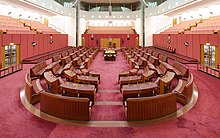 | |
| Senate Chamber Parliament House Canberra, Australian Capital Territory, Australia | |
| Website | |
| Senate | |
The Senate is the upper house of the bicameral Parliament of Australia, the lower house being the Firm of Representatives. The composition and powers of the Senate are established in Chapter I of the Constitution of Australia. There are a total of 76 senators: 12 are elected from each of the six Australian states regardless of population and 2 from each of the two autonomous internal Australian territories (the Australian Capital Territory and the Northern Territory). Senators are popularly elected under the unmarried transferable vote arrangement of proportional representation.
Unlike upper houses in other Westminster-manner parliamentary systems, the Senate is vested with pregnant powers, including the chapters to reject all bills, including budget and cribbing bills, initiated by the authorities in the House of Representatives, making it a distinctive hybrid of British Westminster bicameralism and American-style bicameralism. Equally a result of proportional representation, the sleeping room features a multitude of parties vying for power. The governing party or coalition, which has to maintain the confidence of the lower house, has not held a majority in the Senate since 2005-2007 (and before that since 1981) and usually needs to negotiate with other parties and independents to pass legislation.[one]
Origins and role [edit]

The Australian Senate in 1923
The Democracy of Australia Constitution Human activity (Imp.) of 1900 established the Senate every bit part of the system of Dominion authorities in newly federated Australia. From a comparative governmental perspective, the Australian Senate exhibits distinctive characteristics. Unlike upper Houses in other Westminster organisation governments, the Senate is not a vestigial torso with limited legislative power. Rather it was intended to play – and does play – an agile part in legislation. Rather than being modeled solely later on the Firm of Lords, every bit the Senate of Canada was, the Australian Senate was in part modeled later on the United States Senate, by giving equal representation to each country and equal powers with the lower business firm.[ii] The Constitution intended to give less populous states added vocalization in a Federal legislature, while also providing for the revising role of an upper firm in the Westminster system.
Although the Prime Minister of Commonwealth of australia and Treasurer of Australia, by convention, are members of the Business firm of Representatives (afterwards John Gorton was appointed prime minister in 1968, he resigned from the Senate and was elected to the House), other members of the Chiffonier of Australia may come from either business firm,[three] and the two Houses take near equal legislative ability.[two] As with well-nigh upper chambers in bicameral parliaments, the Senate cannot introduce or improve appropriation bills (bills that authorise government expenditure of public revenue) or bills that impose taxation, that role being reserved for the lower business firm; it tin only approve, refuse or defer them. That degree of equality between the Senate and House of Representatives reflects the want of the Constitution'southward authors to address smaller states' want for strong powers for the Senate equally a way of ensuring that the interests of more populous states equally represented in the Firm of Representatives did not totally boss the government. The Australian constitution was enacted earlier the confrontation in 1909 in Britain betwixt the Firm of Commons and the House of Lords, which ultimately resulted in the restrictions placed on the powers of the House of Lords by the Parliament Acts 1911 and 1949.
In practice, however, most legislation (except for private member'due south bills) in the Australian Parliament is initiated by the Government, which has control over the lower business firm. Information technology is so passed to the Senate, which has the opportunity to improve the bill, pass or reject information technology. In the majority of cases, voting takes place forth party lines, although at that place are occasional conscience votes.
The Senate maintains a number of committees, which appoint in a wide variety of inquiries. The results have no directly legislative power, merely are valuable forums that raise many points of view that would otherwise not receive government or public notice.

Electoral system [edit]
The arrangement for electing senators has inverse several times since Federation. The original organisation involved a first-past-the-mail service and block voting or "winner takes all" system, on a state-by-state basis. This was replaced in 1919 by preferential block voting. Block voting tended to produce landslide majorities and even "wipe-outs". For case, from 1920 to 1923 the Nationalist Party held all but one of the 36 seats, and from 1947 to 1950, the Australian Labor Political party held all but three.
In 1948, single transferable vote with proportional representation on a state-by-state footing became the method for electing senators. At this time the number of senators was expanded from 36 to 60 and it was argued that a move to proportional representation was needed to even upwardly the balance between both major parties in the chamber. The change in voting systems has been described as an "institutional revolution" that has had the effect of limiting the regime's power to command the sleeping accommodation, as well as helping the ascent of Australian minor parties.[4] [five]
The 1984 election saw the introduction of group ticket voting, in order to reduce a loftier rate of informal voting that arose from the requirement that each candidate be given a preference, and to allow small parties and contained candidates a reasonable chance of winning a seat. This allowed voters to select a single political party "Above the Line" to distribute their preferences on their behalf, but voters were yet able to vote directly for individual candidates and distribute their ain preferences if they wished "Below the Line" by numbering every box.[6]
Group tickets were abolished in advance of the 2022 election in order to avoid undue influence of preference deals amongst parties that were seen equally distorting election results[seven] and a course of optional preferential voting was introduced. As a effect of the changes, voters may now assign their preferences for parties higher up the line (numbering as many boxes equally they wish), or individual candidates below the line, and are non required to fill all of the boxes. Both to a higher place and below the line voting at present use optional preferential voting. For to a higher place the line, voters are instructed to number at to the lowest degree their first half dozen preferences; however, a "savings provision" is in identify to ensure that ballots will withal be counted if less than six are given. For beneath the line, voters are required to number at least their get-go 12 preferences. Voters are free to keep numbering as many preferences as they like beyond the minimum number specified. Another savings provision allows ballot papers with at least 6 below the line preferences to exist formal. The voting changes make it more difficult for new modest parties and contained candidates to exist elected to the Senate, but also permit a voter to voluntarily "exhaust" preferences — that is, to ensure their vote cannot menstruum to specific candidates or parties — if none of the voter's candidate preferences are elected.[viii]
The changes were subject to a challenge in forepart of High Courtroom of Australia by sitting S Australian Senator Bob Day of the Family Commencement Party. The senator argued that the changes meant the senators would not be "directly chosen by the people" as required by the constitution. The Loftier Court rejected Day's challenge unanimously, deciding that both above the line and beneath the line voting were consistent with the constitution.[ix] [10]
Ballot paper [edit]
The Australian Senate voting paper under the single transferable vote proportional representation arrangement resembles the following case (shown in 2 parts), which shows the candidates for Victorian senate representation in the 2022 federal election.
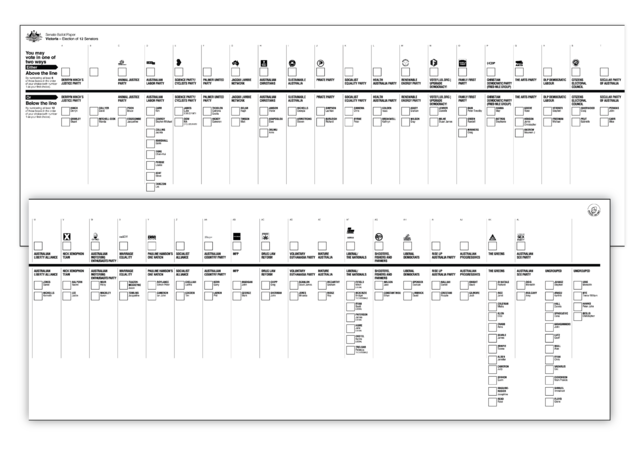
Senate ballot paper used in Victoria for 2016
To vote correctly, electors must either:
- Vote for at to the lowest degree six parties above the thick black line, by writing the numbers 1-6 in political party boxes. Votes with less than vi boxes numbered are however admitted to the count through savings provisions.
- Vote for at least twelve candidates beneath the thick blackness line, by writing the numbers 1-12 in the individual candidates' boxes. Votes with betwixt six and twelve boxes numbered are nevertheless admitted to the count through savings provisions.[eleven]
Considering each state elects six senators at each half-Senate election, the quota for election is only one-seventh or xiv.three% (one third or 33.3% for territories, where merely ii senators are elected). In one case a candidate has been elected with votes reaching the quota amount, any votes they receive in addition to this may be distributed to other candidates as preferences.
With an odd number of seats in a half-Senate election (3 or v), fifty.ane% of the vote wins a majority (two/3) or (iii/5).
With an even number of seats in a one-half-Senate election (6), 57.ane% of the vote is needed to win a majority of seats (4/six).
The ungrouped candidates in the far correct cavalcade practice not have a box above the line. Therefore, they tin only get a chief (number i) vote from electors who vote below the line. For this reason, some independents register every bit a group, either with other independents or by themselves, such equally group B in the above instance.
Names of parties can be shown only if the parties are registered, which requires, among other things, a minimum of 500 members.
Order of parties [edit]
The gild of parties on the ballot papers and the order of ungrouped candidates are determined past a random ballot conducted past the Electoral Committee.
Eolith [edit]
Candidates, parties and groups pay a deposit of $2,000 per candidate, which is forfeited if they fail to accomplish 4% of the primary vote.[12]
Public subsidy [edit]
Candidates, parties and groups earn a public subsidy if they gain at to the lowest degree 4% of the primary vote. At the 2022 federal election, funding was $2.756 per formal outset preference vote.[thirteen]
Membership [edit]
Under sections 7 and 8 of the Australian Constitution:[14]
- The Senate must comprise an equal number of senators from each original state,
- each original country shall accept at least half dozen senators, and
- the Senate must be elected in a style that is non discriminatory amongst united states of america.
These conditions accept periodically been the source of debate, and within these conditions, the composition and rules of the Senate accept varied significantly since federation.
Size and nexus [edit]
Under Section 24 of the Constitution, the number of members of the House of Representatives has to be "as nearly equally practicable" double the number of senators.
The reasons for the nexus are twofold: a desire to maintain a constant influence for the smaller states, and maintain a constant residue of the 2 Houses in the event of a joint sitting after a double dissolution. A plebiscite in 1967 to eliminate the nexus was rejected.
The size of the Senate has inverse over the years. The Constitution originally provided for 6 senators for each state, resulting in a full of 36 senators.
The Constitution permits the Parliament to increase the number of senators, provided that equal numbers of senators from each original state are maintained; accordingly, in 1948, Senate representation was increased from half dozen to 10 senators for each state, increasing the total to lx.
In 1975, the ii territories, the Northern Territory and the Australian Upper-case letter Territory, were given an entitlement to elect two senators each for the showtime time, bringing the number to 64.[xv] The senators from the Northern Territory also represent constituents from Commonwealth of australia'south Indian Ocean Territories (Christmas Island and the Cocos (Keeling) Islands), while the senators from the Australian Capital Territory also represent voters from the Jervis Bay Territory and since 1 July 2016, Norfolk Island.[16]
The latest expansion in Senate numbers took place in 1984, when the number of senators from each country was increased from 10 to 12, resulting in a total of 76 senators.[5]
Term [edit]
Senators commonly serve fixed six-year terms (from 1 July to thirty June). At most federal elections, the seats of 40 of the 76 senators (one-half of the 72 senators from the six states and all four of the senators from the territories) are contested, forth with the entire Business firm of Representatives; such an election is sometimes known every bit a one-half-Senate election. The seats of senators representing states elected at a one-half-Senate election are not contested at the next election, provided it is a half-Senate election. Withal, under some circumstances, the entire Senate (and the Firm of Representatives) is dissolved, in what is known as a double dissolution. Following a double dissolution, half the senators representing states serve terms catastrophe on the third thirty June post-obit the election (two to three years) and the residual serve a five to six-twelvemonth term. Section 13 of the Constitution requires the Senate to allocate long and curt terms amid its members. The term of senators representing a territory expires at the same time every bit there is an ballot for the House of Representatives.
Section 13 of the Constitution requires that in one-half-Senate elections, the ballot of State senators shall take place inside one twelvemonth earlier the places become vacant. The bodily election date is adamant by the Governor of each Land, who acts on the communication of the State Premier. The Governors almost always human activity on the recommendation of the Governor-General, with the last independent Senate election writ being issued by the Governor of Queensland during the Gair Affair in 1974.
Slightly more than one-half of the Senate is contested at each general election (one-half of the 72 state senators, and all iv of the territory senators), forth with the unabridged House of Representatives. Except in the case of a double dissolution, senators for the states are elected for fixed terms of six years, commencing on i July following the ballot, and ceasing on 30 June half dozen years after.
The term of the four senators from the territories is not fixed, but is defined past the dates of the general elections for the Firm of Representatives, the period between which can vary greatly, to a maximum of three years and three months. Territory senators commence their terms on the twenty-four hours that they are elected. Their terms expire the day prior to the following general election twenty-four hour period.[17]
While at that place is no ramble requirement for the ballot of senators to accept place at the aforementioned time as those for members of the House of Representatives, the authorities usually synchronises the dates of elections for the Senate and House of Representatives. Yet, because their terms practise not coincide, the incoming Parliament will for some time comprise the new Firm of Representatives and the old Senate, except for the senators representing the territories, until the new senators start their term on the next 1 July.
Following a double dissolution, all 76 senators face re-ballot. If there is an early House election exterior the 12-month menstruation in which Senate elections can occur, the synchronisation of the election will be disrupted, and there tin can be half-Senate elections without a concurrent House election. The last time this occurred was on 21 November 1970.
Quota size [edit]
The number of votes that a candidate must receive to be elected to the senate is referred to as a "quota". The quota is worked out past dividing the number of formal votes by ane more than than the number of vacancies to be filled and so adding one to the result.[xviii] The 2022 senate election was a half senate election, so 6 senate vacancies were contested in each state. At this election, the quotas in each country were:
| State | 2019 Quota | % of the NSW 2022 Quota | 2016 Double Dissolution Quota[19] |
|---|---|---|---|
| NSW | 670,761 | 100% | 345,554 |
| Vic | 534,207 | 80% | 269,250 |
| Qld | 414,495 | 62% | 209,475 |
| WA | 206,661 | 31% | 105,091 |
| SA | 156,404 | 23% | 81,629 |
| Tas | l,285 | 7% | 26,090 |
Issues with equal representation [edit]
Each state elects the aforementioned number of senators, meaning there is equal representation for each of the Australian states, regardless of population, and then the Senate, like many upper Houses, does not adhere to the principle of "one vote one value". Tasmania, with a population of around 500,000, elects the aforementioned number of senators as New Southward Wales, which has a population of over 8 one thousand thousand. Because of this imbalance, governments favoured past the more populous states are occasionally frustrated by the extra power the smaller states have in the Senate, to the caste that quondam Prime number Minister Paul Keating famously referred to the Senate's members equally "unrepresentative swill".[20] The proportional election system within each state ensures that the Senate incorporates more political diverseness than the lower house, which is basically a ii political party trunk. The elected membership of the Senate more closely reflects the first voting preference of the electorate every bit a whole than does the composition of the House of Representatives, despite the big discrepancies from state to state in the ratio of voters to senators.[21] [22] [23] This oft means that the composition of the Senate is different from that of the House of Representatives, contributing to the Senate's function as a house of review.
With proportional representation, and the small majorities in the Senate compared to the by and large larger majorities in the House of Representatives, and the requirement that the number of members of the Business firm be "nearly as practicable" twice that of the Senate, a articulation sitting after a double dissolution is more than likely than not to pb to a victory for the Business firm over the Senate. When the Senate had an odd number of senators retiring at an election (three or five), 51% of the vote would pb to a clear majority of 3 out of 5 per state. With an even number of senators retiring at an election, it takes 57% of the vote to win 4 out of 6 seats, which may be insurmountable. This gives the Business firm an unintended extra advantage in joint sittings only not in ordinary elections, where the Senate may be too evenly balanced to go Business firm legislation through.
The Regime does non need the back up of the Senate to stay in function; yet, the Senate can block or defer supply, an activeness that precipitated a constitutional crisis in 1975. However, if the governing party does not accept a majority in the Senate, it tin can often notice its agenda frustrated in the upper firm. This can be the case fifty-fifty when the regime has a large majority in the House.
Parties [edit]
The overwhelming majority of senators accept always been elected every bit representatives of political parties. Parties which currently have representation in the Senate are:
- The Coalition – Liberal Party of Commonwealth of australia, National Party of Australia
- Australian Labor Party
- Australian Greens
- Pauline Hanson'southward I Nation
- Heart Alliance
- Jacqui Lambie Network
Other parties that take achieved Senate representation in the past include the Australian Conservatives, United Australia, Derryn Hinch's Justice Party, Family Offset Political party, Australian Democrats, Palmer United Party, Australian Motoring Enthusiast Party, Nuclear Disarmament Party, Liberal Movement, Liberal Democratic Political party and Democratic Labour Party.
Due to the demand to obtain votes statewide, independent candidates have difficulty getting elected. The exceptions in recent times take been elected in less populous States—the onetime Tasmanian Senator Brian Harradine and the former Due south Australian Senator Nick Xenophon. Information technology is less uncommon for a senator initially elected representing a political party to get an independent, most recently in the cases of Senator Lucy Gichuhi not joining the Conservatives following its merger with Family unit Commencement, Senators Rod Culleton and Fraser Anning resigning from One Nation, and Senator Steve Martin being expelled from the Jacqui Lambie Network.
The Australian Senate serves as a model for some politicians in Canada, particularly in the Western provinces, who wish to reform the Canadian Senate so that it takes a more than active legislative office.[24]
There are as well pocket-size factions in the Great britain (both from the right and left) who wish to the see the House of Lords take on a structure similar to that of the Australian Senate.[25]
Casual vacancies [edit]
Section 15 of the Constitution provides that a casual vacancy of a State senator shall be filled past the Land Parliament. If the previous senator was a member of a item political party the replacement must come from the same party, but the Country Parliament may cull not to fill the vacancy, in which example Section eleven requires the Senate to proceed regardless. If the State Parliament happens to exist in recess when the vacancy occurs, the Constitution provides that the State Governor can engage someone to fill the place until fourteen days after the State Parliament resumes sitting.
Procedure [edit]
Work [edit]
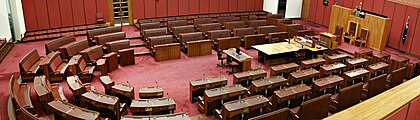
The Australian Senate typically sits for 50 to 60 days a year.[d] Most of those days are grouped into 'sitting fortnights' of two four-day weeks. These are in turn arranged in iii periods: the autumn sittings, from February to April; the winter sittings, which embark with the commitment of the budget in the House of Representatives on the start sitting 24-hour interval of May and run through to June or July; and the bound sittings, which commence around August and continue until December, and which typically contain the largest number of the year's sitting days.
The senate has a regular schedule that structures its typical working week.[26]
Dealing with legislation [edit]
All bills must be passed past a majority in both the House of Representatives and the Senate before they become police. Most bills originate in the Business firm of Representatives, and the groovy bulk are introduced past the authorities.
The usual procedure is for notice to exist given by a government minister the twenty-four hour period before the neb is introduced into the Senate. Once introduced the bill goes through several stages of consideration. It is given a offset reading, which represents the pecker's formal introduction into the chamber.
The first reading is followed by debate on the principle or policy of the bill (the second reading debate). Agreement to the bill in principle is indicated by a 2d reading, after which the detailed provisions of the bill are considered by one of a number of methods (run across below). Bills may also be referred past either House to their specialised standing or select committees. Agreement to the policy and the details is confirmed past a tertiary and terminal reading. These processes ensure that a bill is systematically considered before being agreed to.[27]
The Senate has detailed rules in its standing orders that govern how a bill is considered at each stage.[28] This process of consideration can vary greatly in the amount of time taken. Consideration of some bills is completed in a single day, while complex or controversial legislation may take months to laissez passer through all stages of Senate scrutiny. The Constitution provides that if the Senate vote is equal, the question shall pass in the negative.
Committees [edit]

A Senate committee room in Parliament Business firm, Canberra
A short video on Australian Parliamentary Committees
In add-on to the piece of work of the master bedchamber, the Senate also has a big number of committees which deal with matters referred to them by the Senate. These committees besides deport hearings three times a year in which the government's upkeep and operations are examined. These are known as estimates hearings. Traditionally dominated by scrutiny of government activities by not-government senators, they provide the opportunity for all senators to inquire questions of ministers and public officials. This may occasionally include government senators examining activities of contained publicly funded bodies, or pursuing problems arising from previous governments' terms of office. There is however a convention that senators practise not accept access to the files and records of previous governments when there has been an election resulting in a change in the party in government. Once a particular inquiry is completed the members of the committee tin can then produce a report, to be tabled in Parliament, outlining what they have discovered as well equally any recommendations that they accept produced for the Government to consider.[29]
The ability of the Houses of Parliament to establish committees is referenced in Department 49 of the Constitution, which states that, "The powers, privileges, and immunities of the Senate and of the House of Representatives, and of the members and the committees of each House, shall be such equally are declared by the Parliament, and until declared shall be those of the Commons House of Parliament of the Uk, and of its members and committees, at the establishment of the Commonwealth."[30] [29]
Parliamentary committees can exist given a wide range of powers. 1 of the virtually meaning powers is the ability to summon people to attend hearings in order to give evidence and submit documents. Anyone who attempts to hinder the work of a Parliamentary committee may be establish to be in contempt of Parliament. There are a number of ways that witnesses can be plant in contempt, these include; refusing to appear before a committee when summoned, refusing to answer a question during a hearing or to produce a document, or subsequently being found to have lied to or misled a commission. Anyone who attempts to influence a witness may as well be found in contempt.[31] Other powers include the ability to meet throughout Australia, to establish subcommittees and to take evidence in both public and private hearings.[29]
Proceedings of committees are considered to have the same legal standing equally proceedings of Parliament. They are recorded by Hansard, except for individual hearings, and also operate under Parliamentary privilege. Every participant, including committee members and witnesses giving evidence, is protected from being prosecuted under any ceremonious or criminal activity for anything they may say during a hearing. Written show and documents received by a committee are also protected.[31] [29]
Holding governments to account [edit]
One of the functions of the Senate, both directly and through its committees, is to scrutinise authorities activity. The vigour of this scrutiny has been fuelled for many years past the fact that the party in authorities has seldom had a majority in the Senate. Whereas in the Firm of Representatives the regime's majority has sometimes limited that chamber'south chapters to implement executive scrutiny, the opposition and modest parties have been able to use their Senate numbers as a basis for conducting inquiries into authorities operations. When the Howard Government won command of the Senate in 2005, information technology sparked a debate well-nigh the effectiveness of the Senate in holding the authorities of the day accountable for its actions. Government members argued that the Senate continued to be a forum of vigorous argue, and its committees continued to be agile.[32] The Opposition leader in the Senate suggested that the government had attenuated the scrutinising activities of the Senate.[33] The Australian Democrats, a minor party which oftentimes played mediating and negotiating roles in the Senate, expressed concern almost a diminished role for the Senate's committees.[34]
Voting [edit]
Senators are called upon to vote on matters before the Senate. These votes are called divisions in the case of Senate business organization, or ballots where the vote is to choose a senator to make full an office of the Senate (such as the President).[35]
Political party subject area in Australian politics is extremely tight, so divisions almost always are decided on political party lines. Nevertheless, the beingness of pocket-sized parties belongings the balance of power in the Senate has made divisions in that sleeping accommodation more of import and occasionally more dramatic than in the Firm of Representatives.
When a division is to be held, bells ring throughout the parliament building for 4 minutes, during which time senators must get to the chamber. At the cease of that period the doors are locked and a vote is taken, past identifying and counting senators according to the side of the chamber on which they sit (ayes to the right of the chair, noes to the left). The whole process takes around viii minutes. Senators with commitments that keep them from the chamber may make arrangements in advance to be 'paired' with a senator of the contrary political political party, and then that their absence does non affect the outcome of the vote.
The Senate contains an even number of senators, so a tied vote is a real prospect (which regularly occurs when the party numbers in the sleeping accommodation are finely balanced). Department 23 of the Constitution requires that in the upshot of a tied sectionalization, the question is resolved in the negative. The system is however different for ballots for offices such as the President. If such a ballot is tied, the Clerk of the Senate decides the outcome past the cartoon of lots. In reality, conventions govern nigh ballots, and then this situation does non arise.
Political parties and voting outcomes [edit]
The extent to which party subject area determines the outcome of parliamentary votes is highlighted past the rarity with which members of the same political party will detect themselves on opposing sides of a vote. The exceptions are where a conscience vote is allowed past one or more than of the political parties; and occasions where a member of a political political party crosses the flooring of the chamber to vote confronting the instructions of their party whip. Crossing the floor very rarely occurs, but is more than likely in the Senate than in the Business firm of Representatives.[36]
One feature of the government having a majority in both chambers between 1 July 2005 and the 2007 elections was the potential for an increased accent on internal differences between members of the government coalition parties.[37] This menses saw the first instances of crossing the flooring by senators since the conservative regime took office in 1996:[38] Gary Humphries on civil unions in the Australian Majuscule Territory, and Barnaby Joyce on voluntary educatee unionism.[39] A more significant potential instance of floor crossing was averted when the government withdrew its Migration Amendment (Designated Unauthorised Arrivals) Pecker, of which several authorities senators had been critical, and which would take been defeated had information technology proceeded to the vote.[40] The controversy that surrounded these examples demonstrated both the importance of backbenchers in political party policy deliberations and the limitations to their power to influence outcomes in the Senate chamber.
In September 2008, Barnaby Joyce became leader of the Nationals in the Senate, and stated that his party in the upper house would no longer necessarily vote with their Liberal counterparts.[41]
Where the Houses disagree [edit]
Double dissolutions and articulation sittings [edit]
If the Senate rejects or fails to pass a proposed law, or passes it with amendments to which the House of Representatives will non agree, and if after an interval of three months the Senate refuses to laissez passer the same slice of legislation, the government may either abandon the bill or continue to revise it, or, in certain circumstances outlined in department 57 of the Constitution, the Prime Minister can advise the Governor-General to deliquesce the entire parliament in a double dissolution. In such an event, the entirety of the Senate faces re-election, every bit does the House of Representatives, rather than only virtually half the chamber as is ordinarily the case. After a double dissolution election, if the bills in question are reintroduced, and if they again fail to pass the Senate, the Governor-General may agree to a joint sitting of the 2 Houses in an effort to pass the bills. Such a sitting has merely occurred once, in 1974.
The double dissolution machinery is non available for bills that originate in the Senate and are blocked in the lower house.
On 8 Oct 2003, the then Prime number Minister John Howard initiated public word of whether the mechanism for the resolution of deadlocks between the Houses should be reformed. High levels of support for the existing mechanism, and a very low level of public interest in that discussion, resulted in the abandonment of these proposals.[42]
Allocating terms after a double dissolution [edit]
Later on a double dissolution ballot, section 13 of the Constitution requires the Senate to divide the senators into 2 classes, with the start class having a three-year "short term", and the second class a half-dozen-year "long term". The Senate may adopt whatever approach it wants to determine how to allocate the long and curt terms, however two methods are currently 'on the tabular array':
- "elected-order" method, where the senators elected first accomplish a six-yr term. This approach tends to favour small-scale party candidates as it gives greater weight to their get-go preference votes;[43] or
- re-count method, where the long terms are allocated to those senators who would have been elected first if the election had been a standard half-Senate election.[44] This method is likely to be preferred by the major parties in the Senate where it would evangelize more half-dozen-year terms to their members.[43]
The Senate applied the "elected-order" method following the 1987 double dissolution election.[44] Since that time the Senate has passed resolutions on several occasions indicating its intention to use the re-count method to classify seats at whatever future double dissolution, which Green describes every bit a fairer arroyo but notes could be ignored if a majority of senators opted for the "elected-order" method instead.[44] In both double dissolution elections since 1987, the "elected order" method was used.
Blocking supply [edit]
Because of the federal nature of our Constitution and because of its provisions the Senate undoubtedly has ramble power to refuse or defer supply to the Government. Considering of the principles of responsible regime a Prime Minister who cannot obtain supply, including money for carrying on the ordinary services of government, must either propose a general election or resign. If he refuses to do this I have the say-so and indeed the duty under the Constitution to withdraw his Committee equally Prime Minister. The position in Commonwealth of australia is quite different from a position in the United Kingdom. Here the confidence of both Houses on supply is necessary to ensure its provision. In United Kingdom the confidence of the House of Commons alone is necessary. But both here and in the U.k. the duty of the Prime Minister is the same in a almost important attribute – if he cannot get supply he must resign or advise an ballot.
—Governor-General Sir John Kerr, Statement (dated 11 November 1975)[45]
The constitutional text denies the Senate the power to originate or amend appropriation bills, in deference to the conventions of the classical Westminster arrangement. Under a traditional Westminster organization, the executive authorities is responsible for its utilize of public funds to the lower house, which has the power to bring downward a government by blocking its access to supply – i.e. revenue appropriated through revenue enhancement. The arrangement equally expressed in the Australian Constitution, nonetheless, still leaves the Senate with the power to reject supply bills or defer their passage – undoubtedly one of the Senate's most powerful abilities.
The ability to block supply was exercised in the 1975 Australian ramble crisis. The Opposition used its numbers in the Senate to defer supply bills, refusing to deal with them until an election was called for both Houses of Parliament, an election which information technology hoped to win. The Prime Minister of the day, Gough Whitlam, contested the legitimacy of the blocking and refused to resign. The crunch brought to a head two Westminster conventions that, under the Australian ramble system, were in conflict – firstly, that a government may proceed to govern for as long as information technology has the support of the lower firm, and secondly, that a regime that no longer has access to supply must either resign or be dismissed. The crisis was resolved in November 1975 when Governor-General Sir John Kerr dismissed Whitlam's government and appointed a flagman government on status that elections for both Houses of parliament be held.[45] This action in itself was a source of controversy and debate at that time on the proper usage of the Senate'southward ability to block supply.
The blocking of supply alone cannot strength a double dissolution. There must be legislation repeatedly blocked by the Senate which the government can and then choose to use as a trigger for a double dissolution.[46]
Current Senate [edit]
| Country | Seats held | |||||||||||
|---|---|---|---|---|---|---|---|---|---|---|---|---|
| New South Wales | ||||||||||||
| Victoria | ||||||||||||
| Queensland | ||||||||||||
| Western Australia | ||||||||||||
| South Australia | ||||||||||||
| Tasmania | ||||||||||||
| Australian Upper-case letter Territory | ||||||||||||
| Northern Territory | ||||||||||||
2016 election [edit]
The 2 July 2022 double dissolution election Senate results were: Liberal/National Coalition 30 seats (−3), Labor 26 seats (+1), Greens ix seats (−one), One Nation 4 seats (+4) and Nick Xenophon Team iii seats (+ii). Derryn Hinch won a seat, while Liberal Democrat David Leyonhjelm, Family First's Bob Solar day, and Jacqui Lambie retained their seats. The number of crossbenchers increased by two to a record 20. The Liberal/National Coalition required at least ix boosted votes to reach a Senate majority, an increase of three.[47] [48] [49] The Liberal/National Coalition and Labor parties agreed that the kickoff elected six of twelve senators in each state would serve a vi-year term, while the last 6 elected in each state would serve a three-twelvemonth term, despite two previous bipartisan senate resolutions to use an culling method to allocate long and short term seats. Past doing this, Labor and the Coalition each gained one Senate seat from 2019.[50] [51] [52] [53]
During the 2017–xviii Australian parliamentary eligibility crunch involving dual citizenship, some senators were disqualified past the High Court of Commonwealth of australia and countbacks were conducted to elect replacement senators.
2019 election [edit]
In the 2022 half-senate ballot, 40 seats were up for election, 6 from each country and 2 from each territory. The senate results were: Liberal/National Coalition nineteen seats (+5), Labor 13 seats (+0), Greens six seats (+0), 1 Nation 1 seat (-2), and Jacqui Lambie Network one seat (+1). The composition of the Senate later on the ballot was:
- Liberal/National Coalition 35 seats
- Labor 26 seats
- Greens 9 seats
- 1 Nation 2 seats
- Heart Alliance 2 seats
- Jacqui Lambie Network ane seat
- Independent (Cory Bernardi) 1 seat
Historical political party composition of the Senate [edit]
The Senate has included representatives from a range of political parties, including several parties that have seldom or never had representation in the House of Representatives, but which accept consistently secured a small but meaning level of electoral support, as the table shows.
Results represent the composition of the Senate afterward the elections. The full Senate has been contested on viii occasions; the inaugural ballot and 7 double dissolutions. These are underlined and highlighted in puce.[54]
| Election Year | Labor | Liberal[e] | National[f] | Democratic Labor | Democrats | Greens | CLP | Independent | Other parties | Total seats | Electoral system | ||||
|---|---|---|---|---|---|---|---|---|---|---|---|---|---|---|---|
| 1st | 1901 | 8 | xi[k] | 17 | 36 | Plurality-at-large voting | |||||||||
| 2nd | 1903 | eight | 12[chiliad] | 14 | one | 1 | Revenue Tariff | 36 | Plurality-at-large voting | ||||||
| tertiary | 1906 | 15 | half-dozen[1000] | xiii | 2 | 36 | Plurality-at-large voting | ||||||||
| quaternary | 1910 | 22 | 14 | 36 | Plurality-at-large voting | ||||||||||
| fifth | 1913 | 29 | seven | 36 | Plurality-at-large voting | ||||||||||
| 6th | 1914 | 31 | 5 | 36 | Plurality-at-large voting | ||||||||||
| 7th | 1917 | 12 | 24 | 36 | Plurality-at-big voting | ||||||||||
| 8th | 1919 | 1 | 35 | 36 | Preferential cake voting | ||||||||||
| 9th | 1922 | 12 | 24 | 36 | Preferential block voting | ||||||||||
| 10th | 1925 | 8 | 25 | 3 | 36 | Preferential cake voting | |||||||||
| 11th | 1928 | 7 | 24 | 5 | 36 | Preferential cake voting | |||||||||
| twelfth | 1931 | 10 | 21 | 5 | 36 | Preferential block voting | |||||||||
| 13th | 1934 | 3 | 26 | seven | 36 | Preferential block voting | |||||||||
| 14th | 1937 | xvi | sixteen | 4 | 36 | Preferential block voting | |||||||||
| 15th | 1940 | 17 | 15 | iv | 36 | Preferential block voting | |||||||||
| 16th | 1943 | 22 | 12 | 2 | 36 | Preferential block voting | |||||||||
| 17th | 1946 | 33 | 2 | 1 | 36 | Preferential block voting | |||||||||
| 18th | 1949 | 34 | 21 | 5 | threescore | Single transferable vote (Full preferential voting) | |||||||||
| 19th | 1951 | 28 | 26 | half-dozen | 60 | Single transferable vote | |||||||||
| 20th | 1953 | 29 | 26 | 5 | 60 | Single transferable vote | |||||||||
| 21st | 1955 | 28 | 24 | vi | 2 | 60 | Single transferable vote | ||||||||
| 22nd | 1958 | 26 | 25 | 7 | two | 60 | Single transferable vote | ||||||||
| 23rd | 1961 | 28 | 24 | six | one | ane | 60 | Single transferable vote | |||||||
| 24th | 1964 | 27 | 23 | vii | 2 | ane | 60 | Single transferable vote | |||||||
| 25th | 1967 | 27 | 21 | seven | 4 | 1 | lx | Unmarried transferable vote | |||||||
| 26th | 1970 | 26 | 21 | 5 | 5 | 3 | 60 | Single transferable vote | |||||||
| 27th | 1974 | 29 | 23 | 6 | ane | i | Liberal Movement | sixty | Single transferable vote | ||||||
| 28th | 1975 | 27 | 26 | 6 | 1 | 1 | 1 | Liberal Movement | 64 | Single transferable vote | |||||
| 29th | 1977 | 27 | 27 | 6 | 2 | one | one | 64 | Single transferable vote | ||||||
| 30th | 1980 | 27 | 28 | three | 5 | ane | ane | 64 | Unmarried transferable vote | ||||||
| 31st | 1983 | 30 | 23 | iv | 5 | 1 | 1 | 64 | Single transferable vote | ||||||
| 32nd | 1984 | 34 | 27 | 5 | vii | 1 | one | ane | Nuclear Disarmament | 76 | Unmarried transferable vote (Group voting ticket) | ||||
| 33rd | 1987 | 32 | 26 | 7 | seven | i | 2 | ane | Nuclear Disarmament | 76 | Unmarried transferable vote (Group voting ticket) | ||||
| 34th | 1990 | 32 | 28 | 5 | viii | ane | 1 | 1 | Greens (WA) | 76 | Single transferable vote (Group voting ticket) | ||||
| 35th | 1993 | xxx | 29 | 6 | vii | 1 | 1 | two | Greens (WA) (2) | 76 | Single transferable vote (Group voting ticket) | ||||
| 36th | 1996 | 29 | 31 | 5 | 7 | 1 | 1 | 2 | Greens (WA), Greens (Tas) | 76 | Unmarried transferable vote (Group voting ticket) | ||||
| 37th | 1998 | 29 | 31 | 3 | 9 | i | ane | one | 1 | One Nation | 76 | Single transferable vote (Group voting ticket) | |||
| 38th | 2001 | 28 | 31 | 3 | viii | 2 | 1 | ii | 1 | One Nation | 76 | Single transferable vote (Group voting ticket) | |||
| 39th | 2004 | 28 | 33 | v | 4 | 4 | 1 | i | Family Get-go | 76 | Single transferable vote (Group voting ticket) | ||||
| 40th | 2007 | 32 | 32 | iv | 5 | 1 | i | 1 | Family First | 76 | Single transferable vote (Group voting ticket) | ||||
| 41st | 2010 | 31 | 28 + (3 LNP) | 2 | ane | 9 | 1 | 1 | 76 | Single transferable vote (Group voting ticket) | |||||
| 42nd | 2013 | 25 | 23 + (5 LNP) | iii + (one LNP) | ane | 10 | 1 | 1 | half-dozen | Family unit Get-go, Liberal Democrats, Motoring Enthusiast, Palmer United (3) | 76 | Unmarried transferable vote (Group voting ticket) | |||
| 43rd | 2016 | 26 | 21 + (iii LNP) | iii + (2 LNP) | nine | one | 11 | Family First, Jacqui Lambie, Justice Party, Liberal Democrats, Nick Xenophon Team (3), One Nation (4) | 76 | Single transferable vote (Optional preferential voting) | |||||
| 44th | 2019 | 26 | 26 + (4 LNP) | 2 + (two LNP) | 9 | 1 | 1 | v | Centre Alliance (2), Jacqui Lambie, One Nation (ii), | 76 | Single transferable vote (Optional preferential voting) | ||||
Come across also [edit]
- 2019 Australian federal election
- Canberra Press Gallery
- Clerk of the Australian Senate
- Double dissolution
- Father of the Australian Senate
- Listing of Australian Senate appointments
- Members of the Australian Parliament who take served for at to the lowest degree xxx years
- Members of the Australian Senate, 2019–2022
- Women in the Australian Senate
Notes [edit]
- ^ Including iv Liberal National Party of Queensland (LNP) senators who sit in the Liberals party room.
- ^ Including two Liberal National Party of Queensland (LNP) senators who sit in the Nationals party room.
- ^ Current independent: Sam McMahon (NT).
- ^ Figures are available for each yr on the Senate StatsNet.
- ^ Includes results for the Free Trade Party for 1901 and 1903, the Anti-Socialist Party for 1906, the Commonwealth Liberal Political party for 1910—1914, the Nationalist Political party for 1917—1929, and the United Commonwealth of australia Political party for 1931—1943.
- ^ Used the proper noun State Party for 1919—1974 and National Country Party for 1975—1980.
- ^ a b c Protectionist Party
References [edit]
- ^ Williams, George; Brennan, Sean; Lynch, Andrew (2014). Blackshield and Williams Australian constitutional police force and theory : commentary and materials (6th ed.). Annandale, NSW: Federation Printing. p. 415. ISBN9781862879188.
- ^ a b "Part Five - Powers of the Parliament". Retrieved 13 May 2017.
- ^ "No. fourteen - Ministers in the Senate". Senate Briefs. Parliament of Australia. December 2016.
- ^ Sawer, Marian & Miskin, Sarah (1999). Papers on Parliament No. 34 Representation and Institutional Change: 50 Years of Proportional Representation in the Senate (PDF). Department of the Senate. ISBN0-642-71061-nine.
- ^ a b Department of the Senate, Senate Cursory No. 1, 'Electing Commonwealth of australia's Senators' Archived 29 August 2007 at the Wayback Motorcar. Retrieved August 2007.
- ^ Antony Greenish (23 September 2015). "The Origin of Senate Group Ticket Voting, and it didn't come from the Major Parties". ABC. Retrieved 20 March 2016.
- ^ "Senate voting changes explained in AEC advertisements". abc.net.au. 26 April 2016. Retrieved nine August 2018.
- ^ Stephen Morey (2 May 2019). "Explainer: how does preferential voting work in the Senate?". The Chat. Retrieved 27 November 2019.
- ^ Loftier court rejects Bob Day appeal and finds Senate voting changes are legal, The Guardian, 13 May 2016
- ^ Day v Australian Electoral Officeholder for the Land of Due south Australia [2016] HCA 20
- ^ "Voting in the Senate". Australian Electoral Committee. iv January 2019. Retrieved 27 Nov 2019.
- ^ "Candidate information". Australian Balloter Commission. 17 October 2019. Retrieved 27 Nov 2019.
- ^ "Ballot funding". Australian Balloter Commission. xi June 2019. Retrieved 27 November 2019.
- ^ "Chapter 4, Odgers' Australian Senate Practice". Aph.gov.au. 2 Feb 2010. Archived from the original on 21 March 2011. Retrieved 17 July 2010.
- ^ "Senate (Representation of Territories) Act 1973. No. 39, 1974". Austlii.edu.au. Retrieved 22 March 2017.
- ^ "Norfolk Island Electors". Australian Electoral Commission. 2016. Retrieved 6 August 2016.
- ^ Department 6 of the Senate (Representation of Territories) Act 1973. Retrieved August 2010.
- ^ https://aec.gov.au/Voting/counting/files/senate-count-procedure.pdf
- ^ "Senate results".
- ^ Question without Notice: Loan Council Arrangements House Hansard,
- ^ Lijphart, Arend (one November 1999). "Australian Commonwealth: Modifying Majoritarianism?". Australian Journal of Political Science. 34 (3): 313–326. doi:10.1080/10361149950254. ISSN 1036-1146.
- ^ Sawer, Marian (1999). Marian Sawer; Sarah Miskin (eds.). Overview: Institutional Design and the Role of the Senate (PDF). Representation and Institutional Alter: fifty Years of Proportional Representation in the Senate. Vol. 34. pp. 1–12. Archived from the original (PDF) on 17 January 2011.
- ^ Trudgian, Tim. "Only how representative are the houses of parliament of how Australians vote?". The Conversation . Retrieved 30 May 2018.
- ^ Ted Morton, 'Senate Envy: Why Western Canada Wants What Australia Has' Archived fourteen May 2013 at the Wayback Machine, Senate Envy and Other Lectures in the Senate Occasional Lecture Serial, 2001–2002, Department of the Senate, Canberra.
- ^ Renwick, Alan (2011). House of Lords Reform: A Briefing Paper (PDF). Political Studies Association.
- ^ "Senate weekly routine of business concern". Australian Senate. 7 November 2011. Archived from the original on 26 Jan 2012.
- ^ Australian Senate, 'The Senate and Legislation' Archived 24 September 2008 at the Wayback Machine, Senate Brief, No. 8, 2008, Department of the Senate, Canberra.
- ^ Australian Senate, 'Consideration of legislation' Archived 26 September 2008 at the Wayback Car, Brief Guides to Senate Process, No. 9, Section of the Senate, Canberra.
- ^ a b c d "Odgers' Australian Senate Practice Fourteenth Edition Chapter sixteen - Committees". 2017. Retrieved 19 March 2017.
- ^ Constitution of Australia, department 49.
- ^ a b "Infosheet four - Committees". aph.gov.au. Retrieved 22 Feb 2017.
- ^ "Media Release 43/2006 – Senate remains robust under Authorities bulk". 30 June 2006. Archived from the original on 27 September 2007.
- ^ "Senator Chris Evans, The tyranny of the majority (speech)". 10 November 2005. Archived from the original on 12 November 2009.
Labor has defendant the Government of 'ramming' bills through the Senate – but Labor "guillotined" Parliamentary debate more than twice the number of times in their xiii years in Government than the Coalition has over the last decade. In the concluding half dozen months, the Regime has not sought to guillotine any beak through the Senate.
- ^ "Senator Andrew Murray: Australian Democrats Accountability Spokesperson Senate Statistics 1 July 2005 – 30 June 2006" (PDF). 4 July 2006. Archived from the original (PDF) on 5 Baronial 2006.
- ^ Senate Standing Orders, numbers seven, 10, 98–105, 163
- ^ Deirdre McKeown, Rob Lundie and Greg Baker, 'Crossing the floor in the Federal Parliament 1950 – August 2004' Archived 3 October 2008 at the Wayback Automobile, Research Annotation, No. 11, 2005–06, Department of Parliamentary Services, Canberra.
- ^ Uhr, John (June 2005). "How Democratic is Parliament? A case study in auditing the performance of Parliaments" (PDF). Democratic Audit of Australia, Discussion Paper. Archived from the original (PDF) on fourteen May 2013.
- ^ Peter Veness, 'Crossing floor 'mettlesome, futile', news.com.au, 15 June 2006. Retrieved January 2008.
- ^ Neither of these instances resulted in the defeat of a government proposal, as in both cases Senator Steve Fielding voted with the government.
- ^ Prime number Government minister'south press conference, fourteen August 2006 "Archived copy". Archived from the original on 21 Baronial 2006. Retrieved 21 August 2006.
{{cite web}}: CS1 maint: archived copy as title (link) - ^ "Nationals won't toe Libs' line: Joyce – SMH eighteen/9/2008". News.smh.com.au. 18 September 2008. Retrieved 17 July 2010.
- ^ Consultative Group on Constitutional Change (March 2004). "Resolving Deadlocks: The Public Response" (PDF). p. eight. Archived from the original (PDF) on 17 January 2008.
- ^ a b Uma Patel (half-dozen July 2016). "Election 2016: How do we decide which senators are in for three years and which are in for six?". Australian Broadcasting Corporation.
- ^ a b c Antony Green (25 April 2016). "How Long and Brusque Senate Terms are Allocated After a Double Dissolution". Australian Broadcasting Corporation.
- ^ a b Kerr, John. "Statement from John Kerr (dated 11 November 1975) explaining his decisions". WhitlamDismissal.com. Archived from the original on 23 Feb 2012. Retrieved 11 Jan 2017.
- ^ Dark-green, Antony. "An Early on Double Dissolution? Don't Hold Your Jiff!". Antony Greenish'southward Election Blog. ABC. Retrieved 1 August 2016.
- ^ AEC (21 February 1984). "AEC". Twitter. Retrieved 22 March 2017.
- ^ "Federal Ballot 2016: Senate Results". Australia Votes. Australian Broadcasting Corporation. 3 July 2016. Retrieved 4 July 2016.
- ^ "Senate photo finishes". Blogs.crikey.com.au. 12 July 2016. Retrieved 30 July 2016.
- ^ "Cormann raises 'first elected' plan to halve Senate terms for crossbenchers". The Australian. 12 August 2016. Retrieved eighteen March 2017.
- ^ Hutchens, Gareth (12 August 2016). "Senate terms: Derryn Hinch and Greens' Lee Rhiannon given three years". Retrieved 3 February 2017 – via The Guardian.
- ^ "LP-LNP deal to strength senators dorsum to poll in iii years". The Australian. 13 August 2016. Retrieved 18 March 2017.
- ^ Hunter, Fergus (12 August 2016). "Coalition and Labor team up to clear out crossbench senators in 2019". Sydney Morning Herald . Retrieved three February 2017.
- ^ "A database of elections, governments, parties and representation for Australian state and federal parliaments since 1890". Academy of Western Commonwealth of australia . Retrieved 15 February 2009.
Further reading [edit]
- Bach, Stanley (2003). Platypus and Parliament: The Australian Senate in Theory and Practice. Department of the Senate. ISBN978-0-642-71291-2.
- Harry Evans, Australian Senate Practice, A detailed reference piece of work on all aspects of the Senate's powers, procedures and practices.
- John Halligan, Robin Miller and John Power, Parliament in the Xx-offset Century: Institutional Reform and Emerging Roles, Melbourne University Publishing, 2007.
- Odgers, James Rowland (1948). "The Senate—Example for the Defense force" (PDF). Australian Quarterly. 20 (December): 87–93. doi:10.2307/20633108. JSTOR 20633108.
- Wilfried Swenden, Federalism and Second Chambers: Regional Representation in Parliamentary Federations: the Australian Senate and High german Bundesrat Compared, P.I.East. Peter Lang, 2004.
- Sawer, Marian & Miskin, Sarah (1999). Papers on Parliament No. 34 Representation and Institutional Change: 50 Years of Proportional Representation in the Senate (PDF). Department of the Senate. ISBN0-642-71061-ix.
- Marchant, Sylvia (2009). The Historical Traditions of the Australian Senate: the Upper Business firm we Had to Accept (PDF). Australian National University.
- Viglianti-Northway, Karena (2020). The Intentions of the Framers of the Australian Constitution Regarding Responsible Government and Accountability of the Commonerslth Executive to the Australian Senate (PDF). University of Technology Sydney.
External links [edit]
- Official website of the Australian Senate
- Australian Parliament – alive broadcasting
- Senate StatsNet
- The Biographical Dictionary of the Australian Senate
- Australia'south Upper Houses - ABC Rear Vision A podcast about the development of Commonwealth of australia'due south upper houses into STV proportional representation elected chambers.
Coordinates: 35°xviii′28″Due south 149°07′26″E / 35.30778°S 149.12389°E / -35.30778; 149.12389
Source: https://en.wikipedia.org/wiki/Australian_Senate
0 Response to "30th Sitting of the House of Representative in Trinidad"
Post a Comment